
Talent acquisition has become more complex than simply posting a job and waiting for applications. Organizations today are competing for highly skilled professionals, dealing with large volumes of applications, managing candidate expectations, and trying to make faster hiring decisions without compromising quality.
At the same time, skills are changing rapidly. AI-generated resumes and applications are making traditional screening more difficult, while recruiters are expected to deliver better hiring outcomes with limited time and resources. In India, nearly 74% of recruiters report difficulty identifying qualified candidates, highlighting how challenging skills-to-role matching has become.
This is where artificial intelligence (AI) in talent acquisition can make a significant difference.
AI can automate repetitive recruitment tasks, analyze candidate data, identify relevant skills, improve candidate matching, and provide recruiters with data-driven insights. However, AI should not replace human judgment. Instead, the strongest approach combines AI-powered automation with recruiter expertise.
In this article, we explore the 10 biggest challenges in talent acquisition and how AI can help organizations overcome them.
What Is Talent Acquisition?
Talent acquisition is the strategic process of identifying, attracting, evaluating, and hiring people who have the skills and capabilities an organization needs.
Unlike traditional recruitment, talent acquisition focuses on the entire hiring journey—from workforce planning and sourcing to candidate assessment, selection, and onboarding.
Modern talent acquisition increasingly uses technologies such as artificial intelligence, machine learning, skills analytics, applicant tracking systems, and recruitment automation to improve hiring outcomes.
AI can now support several stages of the recruitment workflow, including job creation, candidate sourcing, screening, skills matching, candidate communication, and interview scheduling.
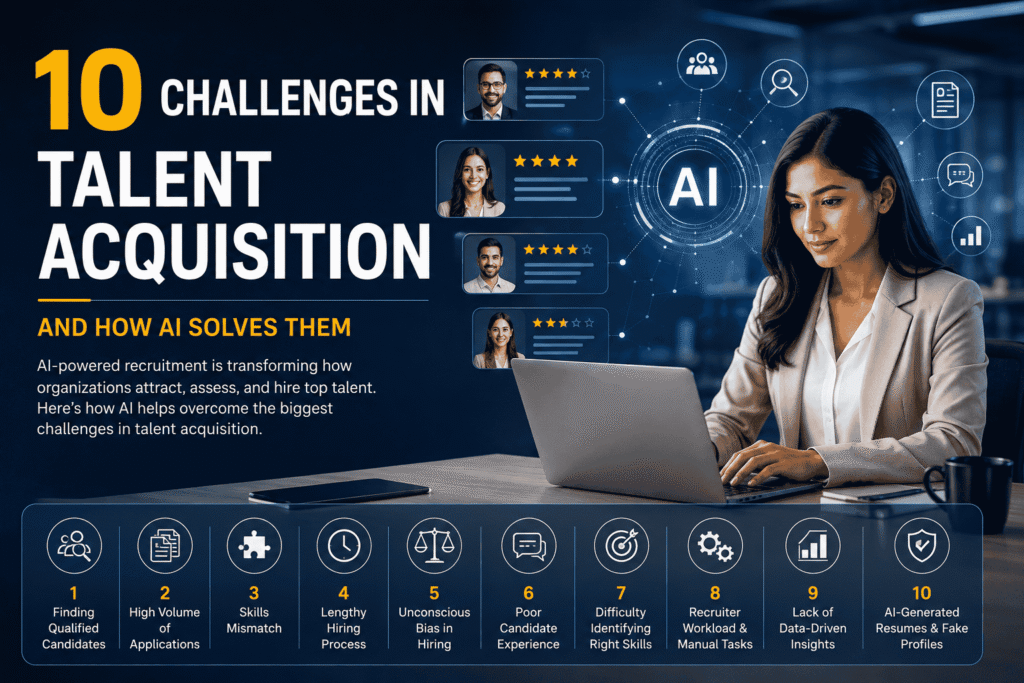
10 Challenges in Talent Acquisition and How AI Solves Them
1. Difficulty Finding Qualified Candidates
One of the biggest talent acquisition challenges is finding candidates who actually have the skills required for a particular position.
A job posting may generate hundreds or even thousands of applications, but only a small percentage may meet the organization’s actual requirements.
Traditional recruitment often relies heavily on resumes, job titles, educational qualifications, and years of experience. These signals don’t always provide a complete picture of a candidate’s capabilities.
How AI Solves It
AI-powered talent acquisition platforms can analyze candidate profiles based on skills, experience, qualifications, career history, and role requirements.
Instead of simply matching keywords, modern AI systems can identify relationships between candidate skills and job requirements.
This allows recruiters to discover qualified candidates who might otherwise be overlooked.
A skills-based approach to hiring is particularly valuable as organizations increasingly prioritize practical capabilities over traditional credentials.
2. High Volume of Applications
Popular job openings can attract hundreds or thousands of applications. Manually reviewing every resume is time-consuming and can slow down the recruitment process.
Recruiters may spend hours searching through applications instead of focusing on candidate engagement, interviews, and strategic hiring activities.
How AI Solves It
AI can automatically process large volumes of candidate profiles and prioritize applicants based on predefined job requirements.
It can identify relevant skills, experience, qualifications, and other important signals to create a more manageable candidate shortlist.
This doesn’t mean AI should make the final hiring decision. Instead, it can reduce the amount of manual screening recruiters need to perform.
The result is a faster and more structured screening process.
3. Skills Mismatch
A candidate may have an impressive resume but still lack the specific capabilities required for a particular role.
At the same time, candidates with transferable or adjacent skills may be rejected because their resumes don’t contain the exact keywords used in the job description.
This creates a major problem for organizations trying to hire in fast-changing industries.
How AI Solves It
AI can analyze skills at a deeper level and identify transferable, adjacent, and related capabilities.
For example, someone with experience in data analytics may possess several skills relevant to a business intelligence role, even if their previous job title was different.
AI-powered skills matching can help recruiters identify these connections.
This approach shifts hiring from “Which candidate has the right job title?” to “Which candidate has the right skills?”
4. Lengthy Hiring Processes
Slow hiring can cause organizations to lose strong candidates.
Talented professionals may receive multiple offers while an organization is still completing resume screening, interviews, approvals, and scheduling.
Long hiring cycles also increase administrative workload for recruiters and hiring managers.
How AI Solves It
AI can automate several repetitive stages of recruitment.
For example, organizations can use AI for:
- Resume screening
- Candidate matching
- Interview scheduling
- Candidate communication
- Interview preparation
- Candidate ranking
- Recruitment analytics
By automating repetitive processes, recruiters can spend more time on high-value activities such as interviewing candidates and building relationships.
The goal isn’t simply to hire faster—it is to create a more efficient hiring process without sacrificing hiring quality.
5. Unconscious Bias in Hiring
Unconscious bias can influence hiring decisions.
Recruiters or hiring managers may unintentionally favor candidates based on factors unrelated to their ability to perform the job.
AI is often presented as a solution to bias, but it is important to understand that AI itself can introduce or reproduce bias if it is trained on biased historical data.
Research into AI-driven recruitment has highlighted concerns that historical hiring patterns can be replicated or amplified by automated systems.
How AI Can Help
When properly designed and governed, AI can support more structured and consistent candidate evaluation.
Organizations can use skills-based criteria and standardized assessment frameworks to reduce the influence of irrelevant factors.
However, AI should not operate without oversight.
Recruiters should regularly review AI recommendations, monitor outcomes, audit models, and maintain human involvement in important hiring decisions.
6. Poor Candidate Experience
Candidate experience has become an important part of talent acquisition.
Candidates expect quick communication, transparent processes, convenient interview scheduling, and clear information about the position.
When candidates don’t receive updates or have to wait weeks between hiring stages, they may lose interest in the organization.
How AI Solves It
AI-powered recruitment systems can automate candidate communication throughout the hiring journey.
AI assistants can help answer common questions, provide application updates, send reminders, and support interview scheduling.
Automation helps candidates receive timely communication while reducing the administrative burden on recruiters.
However, organizations should maintain human interaction at important stages of the hiring process.
7. Difficulty Identifying the Right Skills
One of the most important changes in modern talent acquisition is the shift toward skills-based hiring.
Job titles and degrees alone may not accurately represent what someone can actually do.
This becomes especially important in areas such as artificial intelligence, cloud computing, cybersecurity, data science, and digital technologies, where skill requirements evolve quickly.
How AI Solves It
AI can create detailed skills profiles for both jobs and candidates.
It can analyze:
- Technical skills
- Soft skills
- Certifications
- Experience
- Transferable skills
- Skill gaps
- Career progression
- Role compatibility
This allows organizations to build a more accurate picture of candidate capabilities.
AI-driven skills intelligence can also help organizations identify candidates who have the potential to grow into a role rather than focusing exclusively on candidates who already match every requirement.
8. Recruiter Workload and Administrative Tasks
Recruiters often spend a significant amount of time on repetitive activities such as updating candidate records, reviewing applications, scheduling interviews, sending emails, and preparing reports.
These activities are necessary, but they don’t necessarily require a human to perform every step manually.
How AI Solves It
Recruitment automation can handle many repetitive tasks in the hiring workflow.
AI can help recruiters:
- Organize candidate information
- Prioritize applications
- Generate candidate summaries
- Schedule interviews
- Automate follow-ups
- Identify potential matches
- Analyze recruitment metrics
This allows recruiters to move from being primarily process managers to becoming strategic talent advisors.
9. Difficulty Making Data-Driven Hiring Decisions
Many organizations collect large amounts of recruitment data but don’t always use it effectively.
Recruitment teams may track applications, interviews, hiring rates, time-to-fill, and candidate sources without having a clear way to turn that information into actionable insights.
How AI Solves It
AI-powered recruitment analytics can identify patterns across hiring data.
Organizations can analyze metrics such as:
- Time to hire
- Time to fill
- Candidate conversion rates
- Source effectiveness
- Skills availability
- Candidate quality
- Hiring funnel performance
- Recruitment bottlenecks
These insights can help talent leaders understand where the hiring process is working and where improvements are needed.
AI therefore moves talent acquisition from intuition-driven decision-making toward more evidence-based workforce planning.
10. AI-Generated Resumes and Fake Candidate Profiles
AI has created a new challenge for recruiters: candidates can now generate highly polished resumes and applications with minimal effort.
This makes traditional resume-based screening less reliable.
There are also emerging concerns around candidates using AI-generated identities or assistance during interviews. Recent reports have highlighted cases where organizations encountered suspected fake AI-generated candidates, making identity and candidate verification increasingly important.
How AI Can Help
Ironically, AI can also help organizations respond to AI-generated application fraud.
Modern recruitment systems can combine multiple candidate signals rather than relying solely on resume content.
Organizations can use structured assessments, skills verification, interviews, identity verification, and human evaluation to build a more reliable candidate assessment process.
The future of hiring will therefore require organizations to evaluate what candidates can actually demonstrate—not simply how impressive their resumes look.
How a Talent Acquisition Platform Can Help
Solving individual recruitment problems with disconnected tools can create another problem: fragmented hiring workflows.
A modern talent acquisition platform brings different recruitment activities together in one system.
For organizations looking to modernize their hiring process, Third Bracket’s Talent Acquisition Platform can help create a more intelligent, skills-focused approach to talent acquisition.
Instead of treating recruitment as simply a process of collecting resumes, an AI-powered talent acquisition approach can help organizations understand candidate skills, identify relevant talent, improve candidate matching, and support better hiring decisions.
This is particularly valuable for companies that need to hire at scale or recruit for specialized and rapidly changing roles.
The Future of Talent Acquisition Is Skills-First
The future of talent acquisition is moving toward a skills-first model.
Organizations are increasingly recognizing that job titles, degrees, and traditional career paths don’t always tell the complete story about someone’s capabilities.
AI can help organizations understand talent at a deeper level by connecting skills, roles, experience, potential, and organizational requirements.
At the same time, AI adoption needs appropriate governance. Candidates and employees increasingly expect transparency and fairness when AI is involved in hiring decisions. Recent research and industry discussions emphasize that organizations should combine AI efficiency with human oversight rather than treating AI as a completely autonomous decision-maker.
The winning approach is therefore not AI versus recruiters.
It is AI + recruiters.
AI handles scale, pattern recognition, automation, and data analysis. Recruiters bring empathy, context, judgment, relationship-building, and an understanding of organizational culture.
Conclusion
The talent acquisition landscape is changing rapidly.
From skills shortages and application overload to lengthy hiring processes, skills mismatches, candidate experience issues, bias, and AI-generated applications, organizations face a wide range of recruitment challenges.
AI can help address many of these problems by automating repetitive work, improving candidate matching, supporting skills-based hiring, analyzing recruitment data, and helping recruiters make more informed decisions.
However, successful AI-powered talent acquisition requires more than simply purchasing an AI tool. Organizations need the right processes, quality data, appropriate governance, and human oversight.
The future of recruitment is likely to be faster, more skills-focused, more data-driven, and increasingly intelligent.
Organizations that combine the capabilities of AI with the judgment of experienced recruiters will be better positioned to find the right talent, improve candidate experiences, and build a workforce prepared for the future.
If your organization is looking to modernize its recruitment process, explore the Third Bracket Talent Acquisition Platform to learn how AI-powered talent intelligence can support smarter, skills-based hiring.