
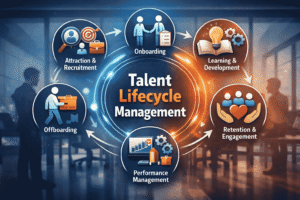
In today’s dynamic business landscape, organizations are realizing that talent isn’t just a resource—it’s a strategic advantage. To harness this advantage, companies are investing in Talent Lifecycle Management (TLM) to attract, develop, and retain top performers. But what exactly is Talent Lifecycle Management, and why should your business prioritize it?

Table of Contents
What is Talent Lifecycle Management?
Talent Lifecycle Management refers to a holistic approach that oversees an employee’s journey from the moment they are attracted to a company to when they exit. It is a structured process that ensures every phase of the employee experience—recruiting, onboarding, development, engagement, retention, and offboarding—is optimized for greater performance and satisfaction.
Rather than treating HR activities as isolated functions, TLM integrates them into a seamless lifecycle that aligns with organizational goals.
Why Talent Lifecycle Management Matters
Today’s workforce is more mobile, diverse, and demanding than ever before. Employees seek meaningful work, continuous development, and workplaces that value their contributions. Traditional HR methods that view employees transactionally are no longer enough. This is where Talent Lifecycle Management steps in.
Here’s why TLM matters:
- Improved Employee Experience: TLM ensures that employees have a clear path from recruitment to career growth.
- Higher Retention Rates: Engaged employees who feel valued and supported are far less likely to leave.
- Stronger Employer Brand: When talent thrives in your organization, your reputation as an employer of choice grows.
- Strategic Workforce Planning: TLM helps identify future leaders and build skills that align with business objectives.
5 Stages of Talent Lifecycle Management
Stage 1 – Hiring the Best Talent
The Challenge:
How do you actually attract and identify the right people in today’s competitive market without endless hiring cycles?
How Third Bracket Helps:
Our AI-powered skills profiling platform and skill-based hiring tools streamline everything from sourcing to shortlisting. No more guessing – just data-driven insights that help you select top talent efficiently and effectively.
Stage 2 – Cultural Alignment
The Challenge:
How do you make sure new hires actually fit your company culture instead of just looking good on paper?
How Third Bracket Helps:
We provide detailed cultural alignment assessments using psychometric and behavioural analysis. Our competency assessment framework matches candidates with your organisational values, reducing turnover and improving team chemistry from day one.
Stage 3 – Skill Profiling
The Challenge:
How can you get a real understanding of your employees’ capabilities and spot the gaps that matter?
How Third Bracket Helps:
Our AI-based talent management platform uses advanced skill profiling tools to map your people’s actual strengths and improvement areas, giving you actionable insights for smarter workforce planning and targeted training.
Stage 4 – Upskilling
The Challenge:
How do you keep your team adaptable and skilled when everything changes so fast?
How Third Bracket Helps:
We create personalised learning paths and skill development programs tailored to what your people and organisation actually need, keeping your workforce ahead of industry trends instead of playing catch-up.
Stage 5 – Career Development
The Challenge:
How do you help employees see their future with you while meeting your business goals?
How Third Bracket Helps:
Our career mapping solutions create clear, data-backed growth paths that show employees their potential within your organisation, fostering genuine long-term engagement and retention.
How Third Bracket Can Help
At Third Bracket, we understand that managing talent isn’t just about filling roles—it’s about shaping careers and strengthening organisational capability. Our TLM solutions offer:
- Tailored recruitment strategies
- Integrated performance & development programs
- Data-driven insights for workforce planning
- Customized engagement initiatives
Our approach ensures your talent strategy is aligned with business goals, enabling you to build a resilient, future-ready workforce.
Conclusion
Talent Lifecycle Management is no longer an HR luxury—it’s a business imperative. By thoughtfully managing the employee journey, organizations can unlock higher performance, stronger engagement, and sustained growth.
Invest in your talent lifecycle. Because when your people succeed, your business thrives – Click here
Top 5 FAQs About Talent Lifecycle Management
What is Talent Lifecycle Management?
Talent Lifecycle Management is a strategic HR approach that manages the entire employee journey — from recruitment and onboarding to performance management, development, retention, and offboarding. It helps organizations optimize workforce productivity, improve employee engagement, and align talent strategies with business goals.
Why is Talent Lifecycle Management important for organizations?
Talent Lifecycle Management is important because it ensures businesses attract, develop, and retain top talent efficiently. By managing every stage of the employee lifecycle, companies can reduce turnover, enhance employee experience, improve performance outcomes, and drive long-term organizational growth.
What are the key stages of Talent Lifecycle Management?
The key stages of Talent Lifecycle Management include:
Workforce Planning
Recruitment & Hiring
Onboarding
Training & Development
Performance Management
Employee Engagement
Retention & Succession Planning
Offboarding
Each stage plays a critical role in maximizing employee potential and organizational success.
How does Talent Lifecycle Management improve employee retention?
Talent Lifecycle Management improves employee retention by providing structured onboarding, continuous learning opportunities, performance feedback, career growth paths, and engagement strategies. When employees feel valued and supported throughout their journey, they are more likely to stay with the organization.
How can companies implement an effective Talent Lifecycle Management strategy?
To implement an effective Talent Lifecycle Management strategy, organizations should:
Use HR technology and analytics tools
Align talent strategy with business objectives
Offer continuous learning and development programs
Monitor employee engagement and performance metrics
Create clear career progression pathways
A data-driven and employee-focused approach ensures sustainable workforce growth and competitive advantage.