
In today’s rapidly evolving business environment, Chief Human Resources Officers (CHROs) are expected to do far more than manage hiring and employee relations. They are strategic business leaders responsible for ensuring organizations have the right talent, capabilities, and culture to achieve long-term success.
As companies navigate digital transformation, AI adoption, changing workforce expectations, and talent shortages, data-driven decision-making has become essential. Modern HR leaders can no longer rely solely on intuition. They need actionable workforce intelligence that provides clear visibility into organizational strengths, risks, and opportunities.
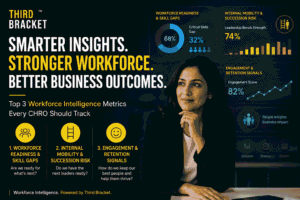
At Third Bracket, we believe that workforce analytics should empower leaders to make smarter decisions, build stronger teams, and drive measurable business outcomes. Among the hundreds of HR metrics available today, three stand out as the most critical indicators of organizational health and future readiness:
- Workforce Readiness & Skill Gaps
- Internal Mobility & Succession Risk
- Employee Engagement & Retention Signals
Let’s explore why these three workforce intelligence metrics should be at the center of every CHRO’s dashboard.

Why Workforce Intelligence Matters More Than Ever
The workforce is changing faster than most organizations can adapt.
New technologies emerge every year. Employee expectations continue to evolve. Skills that were valuable yesterday may become obsolete tomorrow. Meanwhile, business leaders expect HR teams to contribute directly to growth, innovation, and profitability.
This is where workforce intelligence becomes a competitive advantage.
Workforce intelligence combines people data, analytics, and business insights to help organizations understand:
- Current workforce capabilities
- Future talent requirements
- Employee behavior patterns
- Leadership readiness
- Organizational risks
- Retention challenges
Instead of reacting to workforce problems after they occur, companies can proactively identify issues and take corrective action.
The result?
Better hiring decisions, stronger employee experiences, improved productivity, and sustainable business growth.
1. Workforce Readiness & Skill Gaps
Are We Ready for What’s Next?
One of the most important questions every CHRO must answer is:
“Do we have the skills needed to achieve our future business goals?”
Workforce readiness measures how prepared employees are to meet current and future business demands.
As industries embrace automation, artificial intelligence, cloud computing, and digital transformation, many organizations are discovering critical skill gaps within their workforce.
These gaps can slow growth, reduce innovation, and increase operational risks.
What Are Skill Gaps?
A skill gap occurs when employees lack the knowledge, capabilities, or expertise required to perform future roles effectively.
Examples include:
- AI and machine learning skills
- Data analytics capabilities
- Leadership competencies
- Project management expertise
- Digital transformation knowledge
- Industry-specific certifications
Without visibility into these gaps, organizations risk falling behind competitors.
Key Workforce Readiness Metrics
CHROs should monitor:
Skills Inventory Coverage
Understanding which skills currently exist across the organization.
Critical Skill Gap Analysis
Identifying capabilities that are missing or underdeveloped.
Learning & Development Effectiveness
Measuring whether training programs are closing capability gaps.
Future Readiness Index
Assessing workforce preparedness for future business priorities.
Role Readiness Scores
Evaluating employee readiness for upcoming responsibilities.
Business Impact of Workforce Readiness
Organizations that actively manage skill gaps experience:
- Faster digital transformation
- Higher employee productivity
- Reduced hiring costs
- Better innovation outcomes
- Improved organizational agility
Rather than continuously hiring external talent, businesses can develop existing employees and create a stronger internal talent pipeline.
At Third Bracket, workforce intelligence solutions help organizations identify capability gaps early and build targeted development strategies that align with business goals.
2. Internal Mobility & Succession Risk
Do We Have the Next Leaders Ready?
Leadership continuity is one of the biggest challenges facing modern organizations.
Many companies invest heavily in recruitment but overlook a critical question:
“What happens when key leaders leave?”
Without succession planning and internal mobility visibility, organizations face significant risks including:
- Leadership vacancies
- Business disruption
- Knowledge loss
- Reduced employee morale
- Increased recruitment costs
This makes internal mobility and succession risk essential metrics for CHRO dashboards.
Understanding Internal Mobility
Internal mobility refers to employees moving across roles, departments, projects, or leadership positions within the organization.
A healthy internal mobility program allows employees to:
- Grow professionally
- Learn new skills
- Explore career opportunities
- Take on leadership responsibilities
Organizations benefit through:
- Higher retention rates
- Lower hiring costs
- Stronger talent pipelines
- Increased employee engagement
What Is Succession Risk?
Succession risk measures how vulnerable the organization is if critical employees or leaders leave unexpectedly.
For example:
- Is there a successor ready for a senior executive role?
- How many critical positions lack a backup candidate?
- Which departments depend heavily on a single employee?
Without clear answers, businesses remain exposed to operational risks.
Key Internal Mobility & Succession Metrics
Leadership Bench Strength
Measures availability of qualified successors for key leadership roles.
Critical Role Coverage
Identifies positions without succession plans.
Internal Promotion Rate
Tracks how often roles are filled internally.
High-Potential Employee Readiness
Evaluates future leaders’ preparedness.
Talent Mobility Index
Measures employee movement across functions and departments.
Business Benefits
Organizations with strong succession planning achieve:
- Better leadership continuity
- Reduced turnover costs
- Faster leadership transitions
- Higher employee retention
- Stronger organizational resilience
Employees are also more likely to stay when they see clear career advancement opportunities within the company.
This is why workforce intelligence platforms should provide real-time visibility into talent pipelines, leadership readiness, and succession risks.
3. Employee Engagement & Retention Signals
How Do We Keep Our Best People?
Employee retention has become one of the biggest priorities for HR leaders worldwide.
Replacing top talent is expensive, time-consuming, and disruptive.
Research consistently shows that disengaged employees are more likely to:
- Leave the organization
- Deliver lower productivity
- Contribute less innovation
- Impact team morale negatively
The challenge is that engagement issues often remain hidden until employees resign.
Modern workforce intelligence enables organizations to detect retention risks before turnover occurs.
What Are Retention Signals?
Retention signals are indicators that reveal how employees feel about their work experience and whether they are likely to stay with the organization.
These signals may include:
- Employee survey responses
- Manager feedback
- Performance trends
- Internal mobility activity
- Learning participation
- Collaboration patterns
- Absenteeism rates
When analyzed together, these signals help predict potential turnover risks.
Key Engagement Metrics Every CHRO Should Monitor
Employee Engagement Score
Measures overall employee satisfaction and commitment.
Retention Risk Index
Identifies employees at higher risk of leaving.
Manager Effectiveness Score
Evaluates leadership impact on employee experience.
Employee Net Promoter Score (eNPS)
Measures willingness to recommend the organization as a workplace.
Career Growth Sentiment
Assesses employee perception of development opportunities.
Why Engagement Matters
Highly engaged employees are more likely to:
- Deliver exceptional performance
- Stay longer with the company
- Support organizational change
- Collaborate effectively
- Drive innovation
Organizations that actively monitor engagement signals can address concerns early and create a more positive employee experience.
Instead of reacting to resignations, HR leaders can take proactive measures that strengthen retention and workforce stability.
Connecting Workforce Metrics to Business Outcomes
One common mistake organizations make is treating HR metrics as standalone numbers.
The most effective CHROs connect workforce insights directly to business performance.
For example:
Workforce Readiness
Impacts innovation, productivity, and transformation success.
Succession Planning
Supports leadership continuity and operational stability.
Employee Engagement
Drives retention, performance, and customer satisfaction.
When workforce data is connected to business objectives, HR becomes a strategic growth partner rather than a support function.
This is the future of workforce intelligence.
How AI and Analytics Are Transforming HR Decision-Making
Artificial intelligence is reshaping workforce management.
Modern HR analytics platforms can:
- Predict employee turnover
- Identify emerging skill gaps
- Recommend development programs
- Assess leadership readiness
- Detect workforce risks early
- Provide real-time workforce insights
Instead of spending hours compiling reports, HR leaders can focus on strategic decisions that create business value.
Organizations that embrace AI-powered workforce intelligence gain a significant competitive advantage in attracting, developing, and retaining top talent.
The Future CHRO Dashboard
The CHRO dashboard of the future is not simply a collection of reports.
It is a strategic command center that answers critical business questions:
- Are we ready for future workforce demands?
- Do we have the next generation of leaders prepared?
- Are our employees engaged and likely to stay?
By focusing on Workforce Readiness & Skill Gaps, Internal Mobility & Succession Risk, and Engagement & Retention Signals, organizations gain visibility into the factors that directly influence long-term business success.
Final Thoughts
The role of the CHRO has evolved dramatically. Today’s HR leaders are expected to drive transformation, enable growth, and build resilient organizations.
Success depends on having access to the right workforce intelligence.
The most impactful workforce metrics are not necessarily the most complex. They are the ones that help leaders answer critical questions about capability, leadership readiness, and employee retention.
By tracking:
- Workforce Readiness & Skill Gaps
- Internal Mobility & Succession Risk
- Engagement & Retention Signals
organizations can make smarter decisions, build stronger workforces, and achieve better business outcomes.
At Third Bracket, we help organizations transform workforce data into actionable insights that drive growth, improve retention, and strengthen leadership pipelines.
Because when people decisions are powered by intelligence, businesses perform better.
Workforce Intelligence. Powered by Third Bracket.