
In today’s rapidly evolving business landscape, organizations are generating more workforce data than ever before. From recruitment systems and HRMS platforms to learning management systems, performance tools, engagement surveys, and workforce planning software, employee data exists across dozens of disconnected systems.
Yet despite this abundance of information, many organizations still struggle to answer fundamental questions:
- Do we have the right talent for future business needs?
- Which employees are ready for leadership roles?
- Where are our critical skill gaps?
- What is the ROI of our people investments?
- How can we improve internal mobility and retention?
The challenge is not a lack of data. The challenge is fragmented data.
At Third Bracket, we believe that organizations need more than dashboards and reports. They need a connected Talent Intelligence Layer that transforms scattered workforce data into actionable business insights.
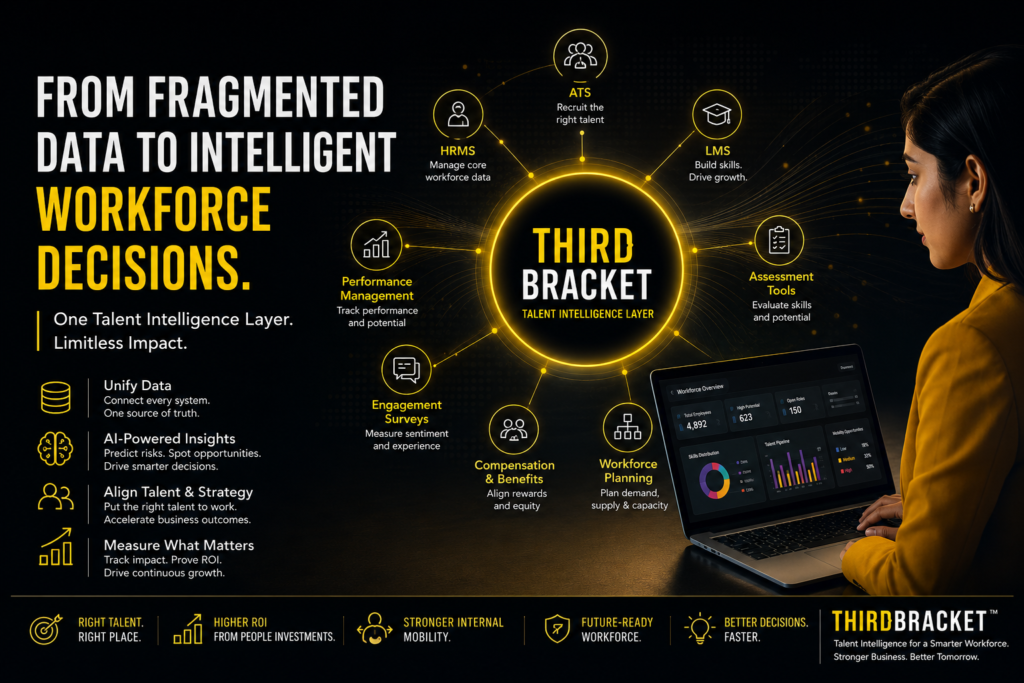
Table of Contents
The Problem: A Fragmented HR Ecosystem
Most modern organizations use multiple HR technologies to manage different aspects of the employee lifecycle.
These often include:
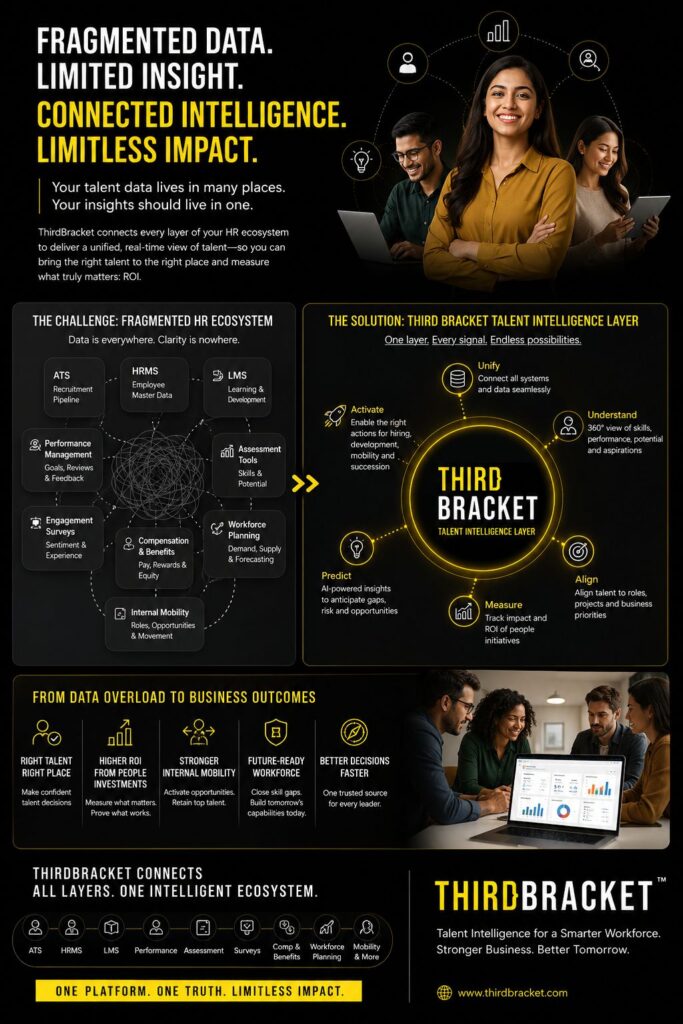
- Applicant Tracking Systems (ATS)
- Human Resource Management Systems (HRMS)
- Learning Management Systems (LMS)
- Performance Management Platforms
- Employee Engagement Tools
- Workforce Planning Solutions
- Assessment Platforms
- Compensation and Benefits Systems
- Internal Mobility Platforms
While each system serves an important purpose, they often operate in isolation.
As a result, HR leaders and business executives face several challenges:
Limited Visibility
Critical workforce information is spread across multiple databases, making it difficult to gain a complete view of employees.
Inconsistent Data
Different systems may contain conflicting or outdated information, creating confusion and reducing confidence in decision-making.
Reactive Workforce Planning
Without connected insights, organizations often react to talent shortages after they occur rather than anticipating them.
Missed Internal Opportunities
Employees with valuable skills and growth potential often remain invisible because their capabilities are scattered across different platforms.
Difficulty Measuring Impact
Companies invest heavily in hiring, training, development, and engagement initiatives but struggle to measure their true business impact.
When data lives everywhere, clarity lives nowhere.
Why Traditional HR Analytics Is No Longer Enough
Many organizations rely on workforce analytics dashboards to monitor HR metrics such as:
- Turnover rates
- Time-to-hire
- Learning completion rates
- Performance scores
- Employee engagement levels
While these metrics are useful, they only tell part of the story.
Traditional analytics answers questions about what happened.
Talent intelligence answers questions about:
- Why it happened
- What will happen next
- What actions should be taken
The future of workforce management requires organizations to move beyond reporting and toward intelligent decision-making.
This is where a Talent Intelligence Layer becomes essential.
What Is a Talent Intelligence Layer?
A Talent Intelligence Layer acts as a unified intelligence engine that connects data across every HR and talent system.
Instead of forcing organizations to replace existing technologies, it sits above them, creating a single source of workforce truth.
The Talent Intelligence Layer continuously gathers, organizes, analyzes, and interprets talent data from across the HR ecosystem.
This enables organizations to:
- Unify workforce data
- Understand workforce capabilities
- Predict talent risks
- Align talent with business priorities
- Measure workforce impact
- Drive strategic decision-making
At Third Bracket, our Talent Intelligence Layer transforms disconnected workforce information into actionable intelligence that leaders can trust.
The Five Core Capabilities of Talent Intelligence
1. Unify Workforce Data
The first step toward intelligent workforce management is creating a connected ecosystem.
Third Bracket integrates information from:
- ATS platforms
- HRMS systems
- LMS platforms
- Performance management tools
- Assessment systems
- Engagement surveys
- Compensation platforms
- Workforce planning applications
This eliminates data silos and creates a comprehensive view of every employee.
With all workforce data connected, organizations gain access to consistent, reliable insights across the entire talent lifecycle.
2. Understand Skills, Potential, and Workforce Readiness
Modern organizations compete on skills.
Yet many businesses struggle to identify:
- Existing workforce capabilities
- Emerging skill gaps
- High-potential employees
- Leadership readiness
- Career aspirations
A Talent Intelligence Layer provides a 360-degree workforce view by combining data from multiple sources.
This helps organizations understand:
- What skills employees possess
- Which skills are developing
- Where future shortages may occur
- Who is ready for advancement
- Which talent segments require investment
This deeper understanding enables smarter talent decisions and stronger workforce planning.
3. Predict Workforce Risks and Opportunities
The most valuable workforce insights are often predictive rather than historical.
Advanced talent intelligence uses AI-powered analytics to identify:
- Potential attrition risks
- Leadership succession gaps
- Future workforce shortages
- Emerging skill demands
- Internal mobility opportunities
Instead of reacting to workforce challenges, organizations can proactively prepare for them.
This shift from reactive HR to predictive workforce strategy creates a significant competitive advantage.
4. Align Talent with Business Goals
One of the biggest challenges organizations face is connecting people strategy with business strategy.
A Talent Intelligence Layer bridges this gap.
By understanding workforce capabilities alongside organizational priorities, leaders can:
- Place the right talent in critical roles
- Build project teams more effectively
- Support business transformation initiatives
- Accelerate innovation
- Improve workforce agility
The result is better alignment between people investments and business outcomes.
When talent and strategy move together, organizations perform better.
5. Measure Workforce ROI
Business leaders increasingly expect HR teams to demonstrate measurable value.
A Talent Intelligence Layer helps organizations track:
- Talent acquisition effectiveness
- Learning and development impact
- Internal mobility outcomes
- Leadership development success
- Retention improvements
- Workforce productivity gains
Rather than relying on assumptions, leaders can clearly see which workforce initiatives generate results.
This creates stronger accountability and better investment decisions.
From Workforce Data to Business Outcomes
Organizations that successfully implement talent intelligence often achieve significant improvements across key business areas.
Right Talent, Right Place
Connected workforce insights help organizations identify the best people for critical roles and projects.
This leads to stronger performance and improved business execution.
Higher ROI from People Investments
Organizations gain visibility into which workforce programs deliver measurable impact.
This enables smarter resource allocation and better returns on investment.
Stronger Internal Mobility
Employees gain greater access to growth opportunities while organizations retain valuable talent.
Internal mobility improves retention, engagement, and workforce flexibility.
Future-Ready Workforce
Talent intelligence helps identify emerging skill needs before they become business challenges.
Organizations can proactively develop capabilities for the future.
Faster, Better Decisions
With a trusted source of workforce intelligence, leaders can make decisions with greater confidence and speed.
The Role of AI in Talent Intelligence
Artificial Intelligence is transforming workforce management.
However, AI is only as effective as the data it receives.
When workforce data remains fragmented, AI models produce incomplete insights.
A connected Talent Intelligence Layer provides the foundation for effective AI adoption by:
- Consolidating workforce data
- Improving data quality
- Identifying patterns across systems
- Delivering predictive recommendations
- Automating workforce analysis
This allows organizations to move beyond static reporting and leverage AI-driven workforce intelligence at scale.
The combination of connected data and intelligent analytics creates a powerful competitive advantage.
Why Talent Intelligence Matters More Than Ever
The future of work is becoming increasingly complex.
Organizations face challenges such as:
- Rapid skill transformation
- Hybrid work environments
- Increased competition for talent
- Workforce demographic shifts
- Accelerated digital transformation
Traditional HR approaches are no longer sufficient.
Leaders need workforce intelligence that is:
- Connected
- Real-time
- Predictive
- Actionable
- Business-focused
Companies that invest in talent intelligence gain a clearer understanding of their workforce and a stronger ability to adapt to change.
Those that continue relying on fragmented systems risk making critical decisions based on incomplete information.
How Third Bracket Creates Connected Workforce Intelligence
Third Bracket was built to solve one of the biggest challenges facing modern organizations: fragmented workforce data.
Our Talent Intelligence Layer connects every component of your HR ecosystem into a unified platform that delivers:
Unified Workforce Visibility
Gain a single source of truth across all talent systems.
AI-Powered Insights
Identify workforce risks, opportunities, and trends before they impact business performance.
Skills Intelligence
Understand workforce capabilities, gaps, and future readiness.
Strategic Workforce Planning
Align talent decisions with business priorities and growth objectives.
Impact Measurement
Track the effectiveness and ROI of workforce investments.
Rather than adding another disconnected tool, Third Bracket acts as the intelligence layer that brings your entire HR ecosystem together.
Conclusion
The organizations that thrive in the future will not be those with the most workforce data.
They will be the ones that can transform workforce data into workforce intelligence.
Fragmented HR systems create fragmented insights. Connected intelligence creates better decisions, stronger talent outcomes, and measurable business impact.
A Talent Intelligence Layer enables organizations to unify data, understand workforce potential, predict future challenges, align talent with strategy, and measure the true impact of people investments.
At Third Bracket, we help organizations move from data overload to meaningful business outcomes by connecting every layer of the workforce ecosystem into one intelligent platform.
One Platform. One Truth. Limitless Impact.
Ready to transform your workforce data into actionable intelligence?
Visit Third Bracket and discover how our Talent Intelligence Layer can help you build a smarter workforce, stronger business outcomes, and a future-ready organization.