
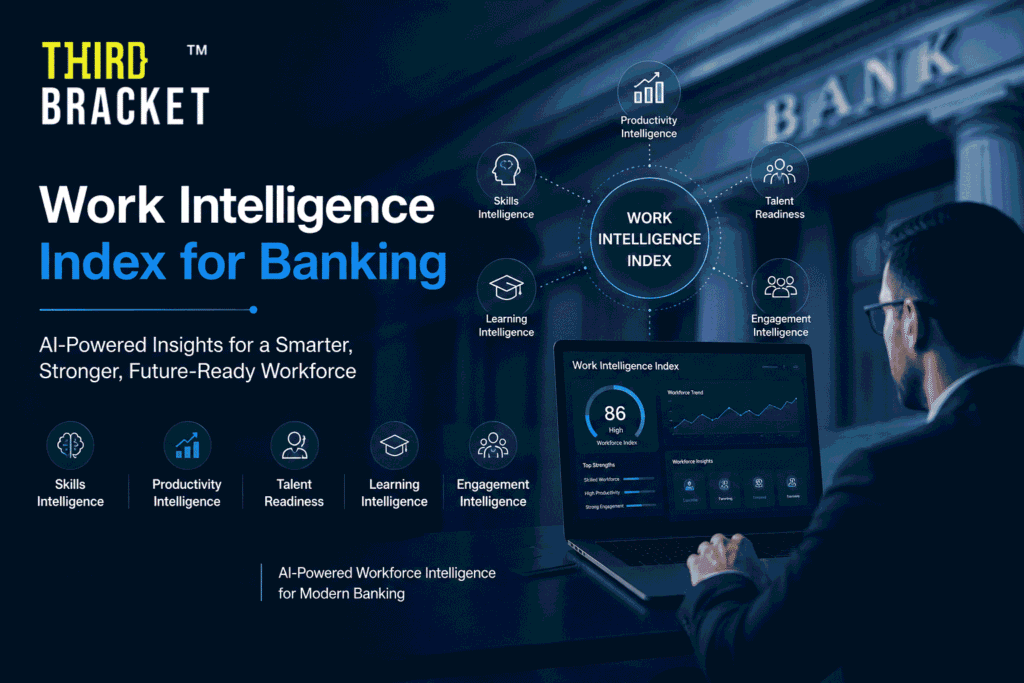
The banking industry is evolving faster than ever before. Digital transformation, AI-powered banking, stricter regulations, and changing customer expectations have completely reshaped how financial institutions operate. While banks continue investing heavily in technology, one factor remains the biggest competitive advantage—the workforce.
This is where the Work Intelligence Index for Banking becomes a game-changing concept. Rather than relying on traditional HR metrics like employee headcount or annual performance reviews, a Work Intelligence Index provides a data-driven view of workforce capabilities, productivity, skills, engagement, and future readiness.
Organizations that leverage workforce intelligence can make smarter hiring decisions, identify skill gaps, improve employee performance, and create a more agile workforce capable of adapting to market changes.
At Third Bracket, we believe that workforce intelligence is the foundation of modern banking success. This guide explains what a Work Intelligence Index is, why it matters, and how banks can use AI-driven workforce insights to build high-performing teams.
What is a Work Intelligence Index for Banking?
A Work Intelligence Index for Banking is a comprehensive framework that measures the overall effectiveness, capability, productivity, and readiness of a bank’s workforce using real-time workforce data and AI analytics.
Unlike traditional HR reports that only provide historical information, a Work Intelligence Index combines multiple workforce indicators to generate actionable insights.
It evaluates areas such as:
- Workforce productivity
- Employee skills and competencies
- Learning progress
- Internal mobility
- Leadership readiness
- Workforce engagement
- Collaboration patterns
- Talent availability
- Succession planning
- Future workforce capability
Instead of asking “How many employees do we have?”, the Work Intelligence Index answers questions like:
- Do we have the right skills for digital banking?
- Which teams are most productive?
- Which employees are ready for leadership?
- Where are the biggest capability gaps?
- Which departments require reskilling?
- How prepared is our workforce for AI adoption?
Why Banking Needs Workforce Intelligence
The banking sector faces constant disruption from fintech companies, digital banking platforms, regulatory changes, cybersecurity threats, and evolving customer expectations.
Banks must continually upgrade workforce capabilities while maintaining operational efficiency.
Some of today’s biggest workforce challenges include:
- Rapid digital transformation
- AI implementation
- Compliance requirements
- Aging workforce
- Skill shortages
- High employee turnover
- Leadership succession
- Remote and hybrid work
- Increased cybersecurity demands
- Rising customer expectations
Without workforce intelligence, banks often make talent decisions based on assumptions instead of real workforce data.
A Work Intelligence Index eliminates this uncertainty by providing measurable workforce insights.
Key Components of a Banking Work Intelligence Index
1. Workforce Skills Intelligence
Modern banking requires expertise in:
- Artificial Intelligence
- Data Analytics
- Risk Management
- Regulatory Compliance
- Cybersecurity
- Cloud Computing
- Digital Payments
- Customer Experience
- Financial Technology
- Relationship Management
A Work Intelligence Index maps employee skills against future business requirements.
Banks can quickly identify:
- Existing capabilities
- Emerging skill gaps
- Critical talent shortages
- Upskilling priorities
2. Productivity Intelligence
Productivity is no longer measured only by hours worked.
Banks evaluate productivity using multiple indicators such as:
- Customer resolution time
- Loan processing speed
- Case completion rates
- Sales effectiveness
- Customer satisfaction
- Cross-functional collaboration
- Operational efficiency
AI continuously analyzes workforce performance to identify improvement opportunities.
3. Talent Readiness
One of the biggest risks in banking is leadership succession.
A Work Intelligence Index helps identify:
- Future leaders
- High-potential employees
- Promotion readiness
- Leadership capability
- Internal mobility opportunities
This ensures business continuity and reduces dependency on external hiring.
4. Learning Intelligence
Banking regulations and technologies change frequently.
Continuous learning is essential.
The Work Intelligence Index tracks:
- Course completion
- Certification progress
- Learning effectiveness
- Skill acquisition
- Knowledge retention
- Learning ROI
Organizations can personalize learning journeys based on employee skill gaps.
5. Employee Engagement Intelligence
Highly engaged employees deliver better customer experiences.
Workforce intelligence measures:
- Employee satisfaction
- Collaboration
- Workload balance
- Retention risks
- Burnout indicators
- Team morale
Banks can proactively improve engagement before productivity declines.
6. Internal Talent Marketplace
Instead of hiring externally, banks can redeploy internal talent.
An AI-powered Work Intelligence Index identifies employees who match open positions based on:
- Skills
- Experience
- Certifications
- Career aspirations
- Performance history
This reduces recruitment costs while improving employee retention.
Benefits of Work Intelligence Index for Banking
Better Hiring Decisions
Banks can identify candidates based on verified skills instead of relying only on resumes.
AI compares candidate capabilities with business requirements, reducing hiring bias and improving recruitment quality.
Improved Workforce Planning
Banks gain visibility into future workforce needs.
This includes:
- Hiring forecasts
- Retirement planning
- Skill demand prediction
- Workforce availability
- Business expansion planning
Strategic workforce planning becomes more accurate and data-driven.
Faster Digital Transformation
Digital banking requires employees with advanced technical skills.
The Work Intelligence Index identifies workforce readiness for technologies such as:
- AI Banking
- Machine Learning
- Automation
- Blockchain
- Cloud Banking
- Digital Payments
Banks can prioritize training programs based on actual capability gaps.
Increased Employee Retention
Employees stay longer when they see career growth opportunities.
Workforce intelligence enables:
- Personalized career paths
- Internal job matching
- Skill development plans
- Promotion opportunities
This creates a culture of continuous growth.
Stronger Compliance
Banking regulations constantly evolve.
The Work Intelligence Index tracks compliance training and certification status, helping banks ensure employees remain up to date with regulatory requirements.
Better Customer Experience
Skilled and engaged employees provide better service.
By improving workforce capability, banks also improve:
- Customer satisfaction
- Service quality
- Response time
- Relationship management
- Customer loyalty
How AI Powers Work Intelligence
Artificial Intelligence transforms workforce data into actionable business insights.
AI can:
- Predict employee turnover
- Identify future skill requirements
- Recommend personalized learning
- Match employees with internal roles
- Forecast workforce demand
- Detect productivity trends
- Analyze workforce sentiment
- Identify leadership potential
Instead of waiting for annual HR reports, leaders receive real-time workforce intelligence.
Measuring a Work Intelligence Index
Although each organization may use different metrics, a comprehensive banking Work Intelligence Index typically evaluates:
Workforce Capability
- Skill coverage
- Certification levels
- Critical skills availability
Productivity
- Output quality
- Operational efficiency
- Service performance
Talent Health
- Retention rate
- Internal mobility
- Promotion readiness
Learning
- Upskilling progress
- Training completion
- Learning effectiveness
Employee Experience
- Engagement
- Collaboration
- Well-being
Leadership Readiness
- Successor availability
- Leadership pipeline
- Future managers
Combining these indicators creates an overall workforce intelligence score that leaders can monitor over time.
Why Traditional HR Metrics Are No Longer Enough
Conventional HR dashboards often focus on:
- Employee count
- Attendance
- Attrition
- Hiring numbers
While useful, these metrics fail to answer strategic questions such as:
- Which employees are future leaders?
- Which teams require reskilling?
- Which capabilities will be needed next year?
- Which business units have the highest workforce risk?
A Work Intelligence Index bridges this gap by delivering predictive, AI-powered workforce insights.
Future Trends in Workforce Intelligence for Banking
The future of banking workforce management will increasingly rely on intelligent technologies.
Emerging trends include:
- AI-powered skill mapping
- Predictive workforce analytics
- Internal talent marketplaces
- Digital employee twins
- Personalized career pathways
- Skills-based hiring
- Intelligent workforce planning
- Workforce risk prediction
- Real-time organizational health monitoring
- Continuous performance intelligence
Banks adopting these innovations will be better positioned to compete in an increasingly digital financial landscape.
How Third Bracket Helps Build Workforce Intelligence
Third Bracket empowers organizations with AI-driven workforce intelligence solutions designed to help enterprises make smarter talent decisions.
Our platform enables banks to:
- Build a comprehensive Work Intelligence Index
- Map workforce skills
- Identify capability gaps
- Improve workforce planning
- Enable internal talent mobility
- Strengthen succession planning
- Support AI-driven hiring
- Deliver personalized learning recommendations
- Enhance workforce productivity
- Align talent strategy with business goals
By transforming workforce data into meaningful insights, Third Bracket helps banking organizations create agile, future-ready teams.
Conclusion
As banking continues its rapid digital evolution, workforce intelligence has become a strategic necessity rather than a competitive advantage.
A Work Intelligence Index for Banking provides leaders with a clear understanding of workforce capabilities, productivity, skills, engagement, and future readiness. Instead of relying on historical HR reports, banks can use AI-powered insights to anticipate workforce needs, close skill gaps, strengthen leadership pipelines, and improve operational performance.
Organizations that invest in workforce intelligence today will be better equipped to adapt to technological disruption, regulatory changes, and evolving customer expectations.
With AI-powered solutions from Third Bracket, banks can transform workforce data into strategic intelligence, enabling smarter decisions, stronger teams, and sustainable business growth in the digital banking era.
Frequently Asked Questions (FAQs)
What is a Work Intelligence Index for Banking?
A Work Intelligence Index is a framework that measures workforce performance, skills, productivity, engagement, and future readiness using AI and workforce analytics.
Why is workforce intelligence important in banking?
It helps banks identify skill gaps, improve hiring, strengthen leadership pipelines, enhance employee productivity, and support digital transformation.
How does AI improve workforce intelligence?
AI analyzes workforce data in real time, predicts future talent needs, recommends learning opportunities, identifies high-potential employees, and supports data-driven workforce planning.
Can a Work Intelligence Index improve employee retention?
Yes. By providing personalized career development, internal mobility opportunities, and targeted learning paths, workforce intelligence helps improve employee satisfaction and retention.
How can Third Bracket help banks implement workforce intelligence?
Third Bracket provides AI-powered workforce intelligence solutions that enable skill mapping, talent analytics, workforce planning, succession planning, internal mobility, and data-driven decision-making for modern banking organizations.