
Hiring the right people has never been more challenging. Organizations today compete not only for customers but also for skilled professionals who can drive innovation and growth. As hiring becomes more competitive, many businesses use the terms talent acquisition and recruitment interchangeably. While they are closely related, they are not the same.
Understanding the difference between Talent Acquisition vs Recruitment is essential for HR leaders, recruiters, and business owners who want to build a sustainable workforce rather than simply fill open positions.
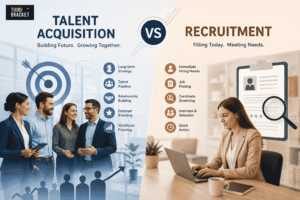
Recruitment focuses on meeting immediate hiring needs, whereas talent acquisition is a long-term strategy designed to attract, engage, and retain top talent. Companies that invest in strategic talent acquisition often experience better employee retention, stronger employer branding, and improved business performance.
In this guide, we’ll explore the differences between talent acquisition and recruitment, their benefits, challenges, and how AI-powered talent acquisition platforms are transforming modern hiring.

What is Recruitment?
Recruitment is the process of identifying, attracting, interviewing, and hiring candidates for specific job openings.
Its primary objective is to fill vacancies as quickly and efficiently as possible.
A typical recruitment process includes:
- Identifying hiring requirements
- Posting job advertisements
- Sourcing candidates
- Screening resumes
- Conducting interviews
- Selecting candidates
- Making job offers
- Onboarding
Recruitment is generally reactive. It begins when a position becomes vacant or a new role is created.
For example, if a software company suddenly needs five Java developers for an upcoming project, the HR team begins recruiting immediately to fill those positions.
The focus is on speed, efficiency, and filling immediate hiring gaps.
What is Talent Acquisition?
Talent acquisition is a strategic and long-term approach to finding, attracting, nurturing, and hiring the best talent.
Instead of focusing only on current vacancies, talent acquisition builds a continuous pipeline of qualified candidates for future business needs.
Talent acquisition includes:
- Workforce planning
- Employer branding
- Candidate relationship management
- Talent pipeline development
- Skill mapping
- Diversity hiring
- Succession planning
- Internal mobility
- Workforce analytics
Rather than asking,
“Who can fill this position today?”
Talent acquisition asks,
“Who will help our organization succeed over the next five years?”
This strategic mindset makes talent acquisition an essential function for organizations experiencing rapid growth or operating in highly competitive industries.
Talent Acquisition vs Recruitment: Key Differences
| Recruitment | Talent Acquisition |
|---|---|
| Focuses on filling current vacancies | Focuses on long-term workforce planning |
| Reactive hiring | Proactive hiring |
| Short-term objective | Long-term strategy |
| Vacancy-driven | Business-growth driven |
| Limited candidate engagement | Continuous candidate relationship building |
| Measures time-to-fill | Measures quality of hire, retention, and workforce readiness |
| Suitable for immediate hiring | Ideal for scaling organizations |
Although recruitment is a component of talent acquisition, talent acquisition encompasses much more than simply hiring employees.
Why Talent Acquisition Matters More Than Ever
Today’s hiring landscape is changing rapidly due to:
- Skills shortages
- Remote work
- AI adoption
- Candidate expectations
- Increased competition for talent
- Digital transformation
Businesses can no longer rely solely on job postings and resume screening.
Candidates expect personalized communication, faster hiring processes, career growth opportunities, and positive interview experiences.
Organizations that fail to adapt often lose top candidates to competitors.
A strong talent acquisition strategy helps organizations stay ahead by building relationships before positions become available.
Benefits of Talent Acquisition
1. Better Quality of Hire
Talent acquisition emphasizes finding candidates whose skills, values, and career goals align with the organization’s long-term objectives.
This leads to better hiring decisions.
2. Lower Employee Turnover
Employees who are selected through strategic talent acquisition are more likely to stay longer because they fit both the role and company culture.
Lower turnover reduces recruitment costs significantly.
3. Stronger Employer Brand
Companies with an effective talent acquisition strategy invest in employer branding.
Positive candidate experiences encourage more professionals to apply in the future.
4. Reduced Hiring Costs
Although talent acquisition requires upfront investment, maintaining a talent pipeline reduces emergency hiring expenses and agency fees over time.
5. Faster Future Hiring
Instead of starting from scratch every time a position opens, recruiters can reach out to candidates already engaged with the organization.
This dramatically reduces hiring time.
When Recruitment is the Right Choice
Recruitment is ideal when organizations need to:
- Fill urgent vacancies
- Hire seasonal employees
- Recruit contract workers
- Expand project teams quickly
- Replace departing employees immediately
In these situations, speed becomes the primary objective.
When Talent Acquisition is the Better Strategy
Talent acquisition works best when organizations want to:
- Scale rapidly
- Build leadership pipelines
- Hire specialized talent
- Improve workforce quality
- Support long-term business goals
- Reduce future hiring risks
Growing companies often combine recruitment with talent acquisition to balance immediate and future hiring needs.
The Role of AI in Modern Talent Acquisition
Artificial Intelligence is reshaping how organizations identify and engage talent.
Modern Talent Acquisition Platforms use AI to automate repetitive tasks while improving hiring accuracy.
AI-powered capabilities include:
- Resume screening
- Candidate matching
- Skill intelligence
- Predictive hiring analytics
- Automated interview scheduling
- Candidate engagement
- Talent pipeline management
Instead of manually reviewing thousands of resumes, recruiters can focus on building relationships and making strategic hiring decisions.
This results in faster hiring and better candidate experiences.
Talent Acquisition Platform vs Traditional Recruitment Software
Traditional recruitment software mainly helps recruiters manage job applications.
Modern Talent Acquisition Platforms go much further.
They provide:
- AI-powered candidate recommendations
- Workforce planning
- Talent intelligence
- Internal mobility
- Candidate relationship management
- Skills analytics
- Recruitment automation
- Employer branding support
These capabilities help organizations make smarter hiring decisions rather than simply processing applications.
If your organization is looking to build a future-ready workforce, explore Third Bracket’s Talent Acquisition Platform to discover how AI-driven hiring, skill intelligence, and recruitment automation can help you attract, assess, and hire the right talent more efficiently.
Common Mistakes Companies Make
Many organizations unknowingly limit their hiring success by:
- Hiring only when vacancies arise
- Ignoring employer branding
- Depending entirely on job portals
- Failing to build candidate relationships
- Measuring only time-to-hire
- Not using workforce analytics
- Overlooking internal talent
These practices may solve immediate hiring needs but often create long-term talent shortages.
Best Practices for Building a Successful Talent Acquisition Strategy
To create an effective talent acquisition strategy:
Invest in Employer Branding
Candidates research companies before applying.
A strong employer brand attracts better talent.
Build Talent Communities
Stay connected with potential candidates through newsletters, webinars, LinkedIn, and professional events.
Use Skills-Based Hiring
Evaluate candidates based on skills and competencies rather than only degrees or years of experience.
Leverage AI
Automation reduces repetitive work while improving hiring quality.
Measure the Right Metrics
Track:
- Quality of hire
- Candidate experience
- Offer acceptance rate
- Employee retention
- Cost per hire
- Hiring manager satisfaction
These metrics provide better insights than time-to-fill alone.
Frequently Asked Questions
Is talent acquisition the same as recruitment?
No. Recruitment focuses on filling current job openings, while talent acquisition is a long-term strategy for attracting, engaging, and retaining top talent.
Which is better: talent acquisition or recruitment?
Neither is universally better. Recruitment is ideal for immediate hiring needs, while talent acquisition supports long-term workforce planning and business growth.
Why do companies invest in talent acquisition?
Organizations invest in talent acquisition to improve hiring quality, strengthen employer branding, reduce turnover, build future talent pipelines, and support strategic growth.
How does AI improve talent acquisition?
AI automates resume screening, candidate matching, interview scheduling, and workforce analytics, allowing recruiters to make faster and more informed hiring decisions.
Conclusion
The debate around Talent Acquisition vs Recruitment is not about choosing one over the other—it’s about understanding when each approach delivers the greatest value.
Recruitment remains essential for filling immediate vacancies, but organizations that want sustainable growth, stronger workforce planning, and higher-quality hires need a comprehensive talent acquisition strategy.
As hiring becomes increasingly competitive, businesses must move beyond reactive recruitment and adopt intelligent, data-driven hiring practices. AI-powered talent acquisition platforms enable organizations to identify the right candidates, build lasting talent pipelines, and make strategic hiring decisions that support long-term success.
Whether you’re hiring for today’s needs or preparing for tomorrow’s opportunities, investing in a modern talent acquisition approach can give your organization a significant competitive advantage.
If you’re ready to modernize your hiring process, Third Bracket’s Talent Acquisition Platform helps organizations streamline recruitment, leverage AI-driven skill intelligence, and build a future-ready workforce with confidence.