
Hiring at a large organization is rarely a simple process. When hundreds or thousands of candidates apply for multiple positions, HR teams can quickly become overwhelmed with resumes, interviews, assessments, offer letters, follow-ups, and recruitment data. Managing all of this manually not only consumes valuable time but can also make it harder to deliver a consistent and efficient candidate experience.
This is where Applicant Tracking System (ATS) and hiring software can make a meaningful difference.
For large organizations, the right recruitment technology can bring the entire hiring process together on one platform. From candidate management and screening to interviews, assessments, offer letters, and reporting, a modern ATS helps recruitment teams organize their workflow and make better hiring decisions.
Third Bracket is designed as an ATS and hiring software solution for large organizations that need smarter hiring, scalable recruitment operations, and better control over their hiring process.
Why Large Organizations Need Advanced Hiring Software
Recruitment becomes increasingly complex as an organization grows.
A small company may manage candidates through spreadsheets, emails, and individual documents. However, these methods become difficult to manage when recruitment teams are handling multiple departments, locations, job openings, and large volumes of candidates.
A large organization may need to manage:
- High-volume candidate applications
- Multiple job openings simultaneously
- Candidate screening and shortlisting
- Interview scheduling and tracking
- Skill and aptitude assessments
- Offer letter generation
- Candidate communication
- Recruitment reports and hiring data
- Multiple recruiters and hiring managers
Without a centralized system, important information can become scattered across emails, spreadsheets, folders, and different tools.
An ATS for large organizations provides a structured environment where recruitment teams can manage these activities from a single platform.
Instead of spending hours searching for candidate information or manually updating recruitment records, HR teams can focus more on evaluating talent and making strategic hiring decisions.
What Is an Applicant Tracking System?
An Applicant Tracking System, commonly known as an ATS, is recruitment software that helps organizations manage candidates throughout the hiring lifecycle.
An ATS can help organize candidate profiles, applications, job openings, screening information, interview stages, assessments, and hiring outcomes.
For large organizations, an ATS is more than just a resume database. It can become the central platform for managing recruitment operations.
A modern hiring platform can help recruiters move candidates through different stages of the recruitment funnel while keeping important information organized and accessible.
This creates a more structured hiring workflow and makes it easier for HR teams to understand what is happening at every stage of recruitment.
AI-Powered Screening for Smarter Recruitment
One of the biggest challenges in high-volume hiring is reviewing a large number of applications.
Recruiters may receive hundreds of resumes for a single position. Going through every profile manually can take significant time, especially when hiring teams are working on multiple roles at the same time.
AI-powered recruitment tools can support the screening process by helping recruiters identify relevant candidate profiles more efficiently.
With intelligent screening capabilities, recruitment teams can spend less time on repetitive administrative tasks and more time evaluating candidates who are a strong fit for the role.
For organizations managing high-volume recruitment, this can help create a more streamlined hiring process.
The goal is not simply to automate recruitment. The goal is to give recruiters better tools to work with large amounts of candidate information while keeping human decision-making at the center of the process.
Centralized Candidate Management
Candidate management becomes challenging when information is spread across different systems.
An ATS brings candidate information into one centralized platform. Recruiters can view candidate profiles, track hiring stages, monitor interview progress, and review relevant recruitment information from a single interface.
A centralized candidate management system can also make collaboration easier between recruiters and hiring managers.
For example, instead of sending candidate details through multiple emails, teams can work with the same recruitment information within the hiring platform.
This creates greater visibility across the recruitment process and helps reduce unnecessary administrative work.
Integrated Assessments for Better Candidate Evaluation
Resumes can provide valuable information about a candidate’s background, but they may not always provide the complete picture.
Depending on the role, organizations may also want to evaluate skills, aptitude, or job-specific capabilities.
This is where integrated candidate assessments can add value.
With assessment capabilities built into the recruitment workflow, organizations can evaluate candidates as part of the overall hiring process rather than relying on disconnected tools.
For large organizations, this can create a more consistent approach to candidate evaluation.
It also allows recruiters to combine information from different stages of the hiring process when making recruitment decisions.
Bulk Offer Letters Save Valuable Time
Offer management can become another time-consuming part of recruitment, particularly when organizations are hiring at scale.
Creating individual offer letters manually can involve repetitive formatting, editing, reviewing, and sending.
A hiring platform with bulk offer letter capabilities can simplify this process.
Recruitment teams can prepare and send offer letters in bulk, helping reduce repetitive administrative work and making the process more efficient.
For organizations hiring large numbers of employees, even small improvements in administrative workflows can save significant time for HR teams.
Custom Templates for Consistent Communication
Every organization has its own communication style and brand identity.
Custom templates allow HR teams to create recruitment documents that reflect the organization’s brand while maintaining consistency across the hiring process.
Whether it is an offer letter or another recruitment communication, standardized templates can help teams avoid creating documents from scratch every time.
This is particularly useful for large organizations where multiple recruiters may be involved in recruitment across different departments or locations.
Built for High-Volume Recruitment
Large organizations need recruitment software that can support complex hiring requirements.
A platform designed for high-volume recruitment can help teams manage multiple job openings and large candidate pipelines without relying entirely on manual processes.
The objective is simple: create a hiring workflow that is easier to manage as recruitment requirements grow.
Scalability is especially important for organizations that regularly recruit across multiple teams, departments, or business functions.
Instead of adding more spreadsheets and disconnected processes as hiring volume increases, organizations can build their recruitment operations around a centralized hiring platform.
Faster Time-to-Hire
A long recruitment cycle can affect both employers and candidates.
For employers, delays can mean that critical positions remain open for longer. For candidates, a slow or unclear hiring process can create frustration.
An ATS can help improve the efficiency of the recruitment workflow by organizing candidate information, streamlining screening, simplifying assessments, and keeping hiring activities structured.
When recruiters have better visibility into the hiring pipeline, it becomes easier to identify where candidates are in the process and what actions need to happen next.
This can contribute to a more efficient time-to-hire.
Better Quality Hiring Decisions
Technology alone does not guarantee a better hire. However, better information and a structured recruitment process can support stronger decision-making.
An ATS can bring candidate information, screening results, interview progress, assessments, and recruitment data together.
This gives hiring teams a more complete view of candidates.
Instead of relying only on a resume or scattered notes, recruiters and hiring managers can work with information collected throughout the recruitment process.
For large organizations, having a consistent and organized hiring workflow can make recruitment more measurable and easier to manage.
Data-Driven Recruitment
Modern recruitment is becoming increasingly data-driven.
HR leaders want to understand more than just how many people were hired. They may also want visibility into recruitment activity, candidate pipelines, hiring stages, and overall recruitment performance.
Hiring software can help organize recruitment data and provide a clearer view of the hiring pipeline.
This can help HR teams identify bottlenecks, understand recruitment patterns, and make more informed decisions about their hiring strategy.
When recruitment data is centralized, organizations can move toward a more structured approach to workforce planning and talent acquisition.
Secure and Organized Hiring Operations
Large organizations handle a significant amount of candidate information. Keeping recruitment data organized and appropriately managed is therefore an important part of the hiring process.
A centralized recruitment platform can help teams maintain candidate information within a structured environment rather than relying on multiple disconnected files and systems.
This can also make it easier for authorized recruitment teams to access the information they need during different stages of the hiring process.
For organizations operating at scale, having a more organized recruitment infrastructure can support both efficiency and operational control.
Why Choose Third Bracket for Enterprise Hiring?
Third Bracket focuses on helping large organizations simplify complex recruitment workflows through an integrated ATS and hiring platform.
The platform brings important recruitment capabilities together, including:
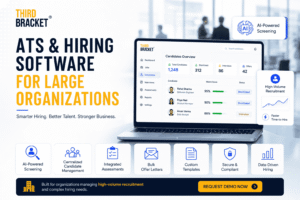
AI-Powered Screening – Streamline candidate screening and identify relevant profiles more efficiently.
Candidate Management – Organize candidate information and track recruitment progress from a centralized platform.
Integrated Assessments – Evaluate candidates using skill and aptitude assessments as part of the hiring workflow.
Bulk Offer Letters – Simplify high-volume offer generation and save administrative time.
Custom Templates – Create recruitment documents that maintain consistency and reflect your organization’s brand.
Interview Management – Keep interview-related activities organized as candidates move through the recruitment process.
Recruitment Reporting – Access organized hiring information to support better visibility and data-driven decisions.
Together, these capabilities are designed to help organizations build a more efficient, scalable, and structured hiring process.
The Future of Hiring Is Smarter and More Connected
Recruitment is changing rapidly. Organizations are no longer looking only for tools that store resumes. They need technology that can support the entire talent acquisition journey.
From AI-assisted screening to assessments, candidate management, interviews, offer letters, and recruitment data, the future of hiring is becoming increasingly connected.
For large organizations, adopting the right ATS and hiring software can help reduce repetitive work, improve recruitment visibility, and create a smoother experience for both recruiters and candidates.
The key is choosing a platform that fits the organization’s hiring volume, workflow, and long-term growth requirements.
Conclusion
Managing recruitment at scale requires more than adding more recruiters or spreadsheets. Large organizations need a hiring process that is organized, efficient, scalable, and easy to manage.
An advanced Applicant Tracking System for large organizations can bring recruitment activities together on a single platform, helping teams streamline candidate management, AI-powered screening, assessments, interviews, offer letters, and reporting.
Third Bracket is built around this idea: smarter hiring, better talent, and stronger business outcomes.
If your organization is managing high-volume recruitment or looking to modernize its hiring process, an integrated ATS can be an important step toward creating a more efficient talent acquisition strategy.
Ready to make your hiring process smarter? Explore Third Bracket and discover a modern ATS and hiring platform built for large organizations.