
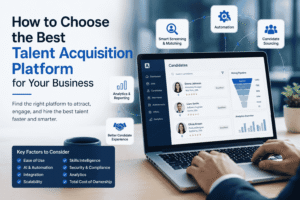
Finding the right talent is one of the biggest challenges businesses face today. As companies grow, managing job postings, applications, candidate communication, interviews, assessments, and hiring decisions manually can quickly become complicated. This is where a talent acquisition platform can make a significant difference.
A modern talent acquisition platform helps organizations streamline recruitment, improve candidate experiences, automate repetitive tasks, and make better hiring decisions using centralized data. However, with so many recruitment and talent acquisition solutions available, choosing the right platform can be difficult.
The best solution is not necessarily the one with the most features. It is the platform that fits your organization’s hiring needs, workforce strategy, budget, existing technology, and future growth plans.
In this guide, we will explain how to choose the best talent acquisition platform for your business, the key features you should evaluate, common mistakes to avoid, and questions to ask before making a decision.
What Is a Talent Acquisition Platform?
A talent acquisition platform is software designed to help organizations manage and optimize the recruitment process from attracting candidates to hiring them.
Unlike a basic applicant tracking system (ATS), a comprehensive talent acquisition platform may support multiple stages of the hiring journey, including:
- Workforce and hiring planning
- Job creation and distribution
- Candidate sourcing
- Applicant tracking
- Resume screening
- Candidate assessment
- Interview management
- Recruitment automation
- Candidate relationship management
- Hiring analytics and reporting
- Recruitment marketing
- AI-powered talent matching
By bringing these processes into one system, businesses can reduce administrative work and create a more structured recruitment process.
Why Choosing the Right Talent Acquisition Platform Matters
Recruitment directly affects business growth. Hiring the wrong candidate can result in lost productivity, additional recruitment costs, and employee turnover. At the same time, a slow hiring process can cause talented candidates to accept offers from competitors.
The right talent acquisition platform can help businesses:
Reduce time-to-hire: Automation can speed up repetitive recruitment activities and help recruiters focus on high-value tasks.
Improve candidate experience: Faster communication, easier applications, and organized interview processes can create a better experience for candidates.
Improve hiring quality: Data-driven insights and skills-based matching can help recruiters make more informed decisions.
Increase recruiter productivity: Automating administrative tasks gives recruitment teams more time to engage with candidates and hiring managers.
Centralize recruitment data: Instead of managing information across spreadsheets, emails, and disconnected tools, teams can manage recruitment data from one platform.
For these reasons, selecting the right platform should be treated as a strategic business decision rather than simply another software purchase.
How to Choose the Best Talent Acquisition Platform for Your Business
1. Identify Your Recruitment Challenges
Before comparing platforms, understand what you want the software to solve.
Are recruiters spending too much time screening resumes? Are applications coming from multiple sources and difficult to track? Is communication with candidates inconsistent? Are hiring managers struggling to collaborate with recruiters?
Create a list of your current recruitment challenges and prioritize them.
For example, a growing organization may need better candidate sourcing and automation, while a large enterprise may require advanced analytics, integrations, compliance capabilities, and support for high-volume hiring.
Your requirements should drive your platform selection—not the other way around.
2. Look for an Easy-to-Use Interface
A platform can have dozens of powerful features, but they are not valuable if recruiters cannot use them efficiently.
Look for an intuitive interface that allows recruiters and hiring managers to quickly:
- Create and manage job requisitions
- Search candidate profiles
- Review applications
- Schedule interviews
- Communicate with candidates
- Track hiring progress
- Access recruitment reports
During a product demonstration, ask the vendor to show you how common recruitment tasks are completed. This will give you a better understanding of the actual user experience.
3. Evaluate AI and Automation Capabilities
AI is becoming an important component of modern talent acquisition technology.
A strong platform may use AI to help recruiters automate tasks such as resume screening, candidate matching, job description creation, sourcing, interview analysis, and talent recommendations.
However, businesses should look beyond the term “AI.”
Ask vendors:
- What recruitment tasks can actually be automated?
- How does the AI match candidates to jobs?
- Is the system skills-based?
- Can recruiters review and override AI recommendations?
- How transparent are AI-generated recommendations?
- What controls exist to support responsible and fair hiring?
The goal should be to use AI to improve recruiter productivity and decision-making rather than blindly automate hiring decisions.
4. Check Candidate Sourcing Capabilities
Finding qualified candidates is often more difficult than managing applications.
The best talent acquisition platform for your organization should support multiple sourcing channels and make it easier to discover relevant talent.
Depending on your requirements, look for features such as:
- Job board integrations
- Career site integration
- Employee referrals
- Talent pools
- Candidate relationship management
- Passive candidate sourcing
- Internal talent discovery
- Skills-based candidate search
A strong sourcing capability can help recruiters move beyond simply waiting for candidates to apply.
5. Consider Skills-Based Hiring
Traditional recruitment often focuses heavily on job titles, degrees, and previous roles. Modern organizations are increasingly looking at the actual skills candidates possess.
A talent acquisition platform with skills intelligence can help organizations identify candidates based on relevant capabilities rather than relying only on keywords in resumes.
For example, a company hiring for a data analyst role may want to identify candidates with skills such as SQL, Python, data visualization, statistics, and business analysis—even if their previous job title was different.
Skills-based hiring can expand the available talent pool and help businesses identify candidates who may otherwise be overlooked.
6. Review Integration Capabilities
Your talent acquisition platform should work with the technology your organization already uses.
Check whether the platform integrates with systems such as:
- Human resource management systems (HRMS)
- Human capital management (HCM) platforms
- Payroll systems
- Job boards
- Background verification tools
- Assessment platforms
- Video interview tools
- Calendar applications
- Communication platforms
- Identity and access management systems
Strong integrations reduce duplicate data entry and help create a connected recruitment ecosystem.
Ask vendors whether integrations are native, API-based, or dependent on third-party connectors. Also clarify whether additional integration costs apply.
7. Examine Recruitment Analytics and Reporting
Recruitment teams need data to understand what is working and what needs improvement.
A good talent acquisition platform should provide meaningful recruitment analytics rather than simply displaying large amounts of data.
Important metrics may include:
- Time-to-hire
- Time-to-fill
- Cost-per-hire
- Source of hire
- Candidate conversion rates
- Interview-to-offer ratio
- Offer acceptance rate
- Recruitment funnel performance
- Recruiter productivity
- Hiring manager performance
Advanced analytics can help organizations identify bottlenecks and improve their overall talent acquisition strategy.
8. Assess Scalability
Your recruitment requirements today may not be the same two or three years from now.
If your organization plans to expand into new markets, increase hiring volume, or build more sophisticated workforce strategies, your platform should be able to scale with you.
Consider:
- Number of users supported
- Candidate database capacity
- Multi-location hiring
- Multiple languages and currencies
- Enterprise security
- Workflow customization
- Reporting capabilities
- API availability
Choosing a scalable platform can prevent the need for another expensive technology migration as your organization grows.
9. Prioritize Security and Compliance
Recruitment platforms handle sensitive candidate information, including resumes, contact details, employment history, interview records, and assessment results.
Security should therefore be a major part of your evaluation.
Ask vendors about:
- Data encryption
- Access controls
- User permissions
- Data retention policies
- Audit logs
- Backup procedures
- Privacy controls
- Compliance certifications
- Data hosting and residency
Your legal and HR teams should also review whether the platform aligns with the data protection and employment regulations relevant to your organization.
10. Compare Total Cost of Ownership
Pricing is important, but the cheapest platform may not provide the best value.
When comparing vendors, consider the complete cost of ownership, including:
- Subscription fees
- Implementation costs
- Customization
- Integration costs
- Training
- Support
- Data migration
- Additional users
- Premium features
Instead of asking only, “How much does the software cost?”, ask, “What business value will this platform create?”
A platform that saves hundreds of recruiter hours and improves hiring efficiency may provide significantly better ROI than a cheaper solution with limited automation.
Common Mistakes to Avoid When Choosing a Talent Acquisition Platform
Businesses often make avoidable mistakes during the selection process.
Choosing Too Many Features
More features do not automatically mean a better platform. Focus on capabilities that solve your actual recruitment challenges.
Ignoring User Experience
If recruiters and hiring managers find the platform complicated, adoption can become a major problem.
Focusing Only on Price
A low subscription cost can become expensive if the platform requires extensive customization, manual work, or additional tools.
Not Testing the Platform
Always request a demo or trial where possible. Give actual recruiters and hiring managers an opportunity to test the platform.
Overlooking Future Requirements
Think beyond your current hiring needs. The platform should support your organization’s future recruitment and workforce strategy.
Questions to Ask Before Buying a Talent Acquisition Platform
Before signing a contract, ask the vendor:
- Which recruitment processes can be automated?
- How does the platform use AI?
- Does it support skills-based hiring?
- What integrations are available?
- Can the platform scale with our hiring volume?
- What analytics and reports are included?
- How secure is candidate data?
- What implementation and training support is provided?
- What is included in the subscription price?
- Can we customize workflows according to our recruitment process?
The answers will help you compare vendors based on business value rather than marketing claims.
Final Thoughts
Choosing the best talent acquisition platform for your business requires more than comparing feature lists. The right solution should address your recruitment challenges, improve recruiter productivity, enhance the candidate experience, support data-driven hiring, and adapt as your organization grows.
Start by defining your requirements, identify the recruitment processes you want to improve, and then evaluate platforms based on usability, automation, AI capabilities, skills intelligence, integrations, analytics, scalability, security, and total cost.
Most importantly, involve the people who will actually use the platform. Recruiters, hiring managers, HR leaders, IT teams, and other stakeholders can provide valuable insights that help you select a solution that works in the real world.
A well-chosen talent acquisition platform is not simply a recruitment tool. It can become an important part of your broader talent strategy—helping your organization find the right people faster, make better hiring decisions, and build a stronger workforce for the future.
Frequently Asked Questions
What is the best talent acquisition platform?
The best talent acquisition platform depends on your organization’s hiring volume, recruitment challenges, budget, technology ecosystem, and long-term talent strategy. Businesses should compare platforms based on usability, automation, AI, integrations, analytics, security, scalability, and ROI.
What is the difference between an ATS and a talent acquisition platform?
An applicant tracking system primarily helps organizations manage candidates and recruitment workflows. A broader talent acquisition platform can include ATS functionality along with sourcing, recruitment marketing, candidate relationship management, AI-powered matching, analytics, automation, and other capabilities.
How does AI improve talent acquisition?
AI can help automate repetitive recruitment activities such as candidate matching, resume screening, sourcing, job description creation, and recruitment analytics. It can help recruiters work more efficiently while allowing human decision-makers to remain involved in important hiring decisions.
Why is skills-based hiring important?
Skills-based hiring focuses on what candidates can actually do rather than relying only on job titles, degrees, or previous roles. It can help organizations discover a broader pool of qualified talent and improve the alignment between candidate capabilities and job requirements.
What should businesses consider when selecting recruitment software?
Businesses should consider their recruitment goals, ease of use, AI and automation capabilities, sourcing tools, skills intelligence, integrations, analytics, security, scalability, implementation support, and total cost of ownership before selecting a platform.