
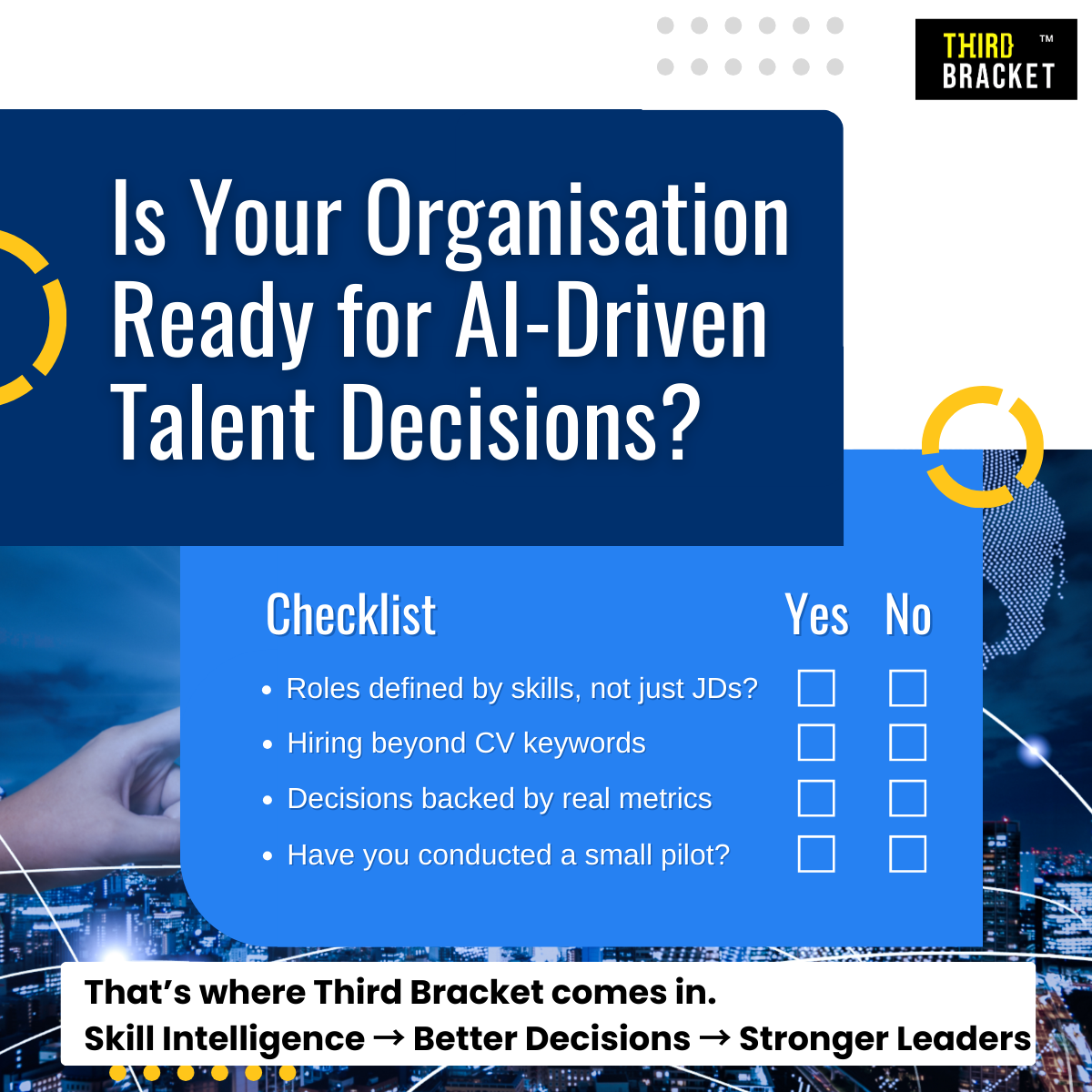
What Are AI-Driven Talent Decisions?
AI-driven talent decisions refer to the use of artificial intelligence technologies—such as machine learning, predictive analytics, and natural language processing—to inform and automate key human capital decisions. These can include:
- Recruitment and candidate sourcing
- Performance evaluation and promotions
- Succession planning
- Learning and development recommendations
- Attrition prediction and retention strategies
Rather than replacing human judgment, effective AI augments decision-making with data-driven insights, helping organisations make smarter, faster, and fairer talent choices.
Why Organisations Are Turning to AI for Talent Decisions
Before we evaluate readiness, it’s important to understand why AI is becoming indispensable in talent management:
🚀 1. Data at Scale
Organisations today collect vast amounts of HR data—performance records, engagement surveys, recruitment metrics, training histories, and more. AI can analyse this data to uncover patterns and insights that humans could never detect at scale.
🤝 2. Reducing Bias
Traditional talent decisions are susceptible to biases—whether conscious or unconscious. AI can help level the playing field by focusing on objective performance indicators and predictive patterns.
⚡ 3. Enhanced Speed and Efficiency
Manual HR processes are time-consuming. AI accelerates routine tasks such as screening CVs, recommending candidates, or matching employees to learning pathways.
📈 4. Strategic Workforce Planning
AI provides predictive insights that help leaders forecast talent needs, identify skill gaps, and stay ahead of workforce challenges before they impact performance.
But with all these benefits, readiness matters. Let’s break it down.
5 Pillars of Readiness for AI-Driven Talent Decisions
To successfully leverage AI in talent decisions, organisations must prepare across multiple dimensions. Here are the core pillars of readiness:
1. Data Infrastructure and Quality
AI is only as good as the data it consumes.
Ask yourself:
- Do you have a centralized HR data repository?
- Is your data clean, consistent, and accessible?
- Can different HR systems talk to each other?
Without reliable data, AI models produce flawed insights. Investing in a unified HR information system (HRIS), data governance practices, and ongoing data quality management is foundational.
Checklist:
✔ HR data warehouse or integrated platform
✔ Standardized data fields across systems
✔ Regular audits and data cleansing
2. Ethical Framework and Fairness
AI systems can inadvertently embed bias if not carefully governed.
Organisations must ensure that AI tools promote fairness and comply with ethical standards.
Key considerations:
- Has your organisation defined ethical guardrails for AI?
- Do you have transparency in decision logic?
- Are there mechanisms to detect and correct bias?
A clear AI ethics policy should outline acceptable use, accountability, and audit procedures.
3. Technological Capability
Deploying AI isn’t plug-and-play. Your technology landscape must support advanced analytics.
Questions to evaluate:
- Do you have in-house data scientists or access to AI expertise?
- Can your current systems support predictive modelling?
- Are you investing in cloud or scalable computing?
Partnering with AI vendors is helpful, but internal capabilities ensure sustainability and alignment with organisational goals.
4. Leadership Sponsorship and Cultural Readiness
AI adoption is as much a cultural shift as a technological one.
Organisations need leaders who champion innovation and foster a culture of data-driven decision-making.
Indicators of readiness:
- Leaders actively promote analytics in HR decisions
- Open mindset toward AI among managers and employees
- Learning culture that encourages experimentation
Without executive buy-in, AI initiatives risk being siloed or underutilised.
5. Change Management and Skills Development
Transitioning to AI-driven talent decisions involves change at every level.
Employees may fear displacement or loss of control. HR professionals may worry about being replaced.
To prepare your workforce:
- Communicate how AI augments rather than replaces human roles
- Provide training on interpreting AI insights
- Build cross-functional teams to bridge HR, IT, and analytics
Remember: The most successful AI transformations are human-centric and supported by structured change management.
Common Pitfalls to Avoid
❌ Rushing Implementation Without Clear Objectives
Deploying AI without defining what you want to achieve leads to wasted investment and confusion.
Tip: Set measurable goals—e.g., reduce time-to-hire by 30%, increase retention in key roles by 15%.
❌ Ignoring Data Privacy and Compliance
Handling employee data comes with legal responsibilities. Ensure your AI practices comply with data protection laws.
❌ Treating AI as a Silver Bullet
AI enhances capability but doesn’t replace strategic HR thinking. Combine AI insights with human judgment.
How to Begin the AI Journey in Talent Decisions
Here’s a step-by-step guide to get started:
Step 1: Conduct an AI Readiness Audit
Evaluate your data, technology, skills, and culture. Identify gaps and prioritise areas for investment.
Step 2: Define Clear Use Cases
Start with high-impact, low-risk scenarios such as CV screening or employee skill mapping.
Step 3: Build a Cross-Functional Team
Bring together HR, data science, IT, and compliance professionals to drive collaboration.
Step 4: Choose the Right Tools
Select AI tools that align with your specific needs and organisational maturity.
Step 5: Pilot and Learn
Begin with small pilots, measure outcomes, and iterate before scaling.
Step 6: Govern and Sustain
Establish ongoing monitoring, ethical review, and continuous improvement mechanisms.
The Future is Here — But Readiness Determines Success
AI-driven talent decisions are no longer a futuristic concept—they are reshaping how organisations attract, develop, and retain talent today. But jumping on the bandwagon without readiness can lead to disappointment, wasted resources, and even ethical pitfalls.
By building strong data foundations, fostering ethical practices, empowering your workforce, and embracing a culture of innovation, your organisation can unlock the full potential of AI in talent management.
As a partner in HR transformation, ThirdBracket believes that preparedness isn’t optional—it’s essential. The organisations that invest in readiness today will be the talent leaders of tomorrow.
Take the Next Step
Are you ready to assess your organisation’s readiness for AI-driven talent decisions? Connect with ThirdBracket’s experts to build a roadmap tailored to your business needs.
Visit: https://www.thirdbracket.in/
Empower your workforce with intelligence.