
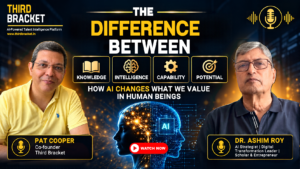
Artificial intelligence is changing the way we work, learn, solve problems, and make decisions. Tasks that once required years of experience can now be supported by intelligent tools that analyse information, generate insights, and automate complex processes. As AI continues to evolve, one important question is emerging for businesses and individuals alike: What truly makes a person valuable in an AI-driven world?
For decades, organizations have evaluated people through qualifications, professional experience, technical knowledge, and past achievements. These factors remain important, but they no longer tell the complete story. When technology can provide instant access to information and perform many routine cognitive tasks, understanding what a person knows is only part of the equation.
To make better talent decisions, organizations need to look beyond traditional measures and understand four interconnected dimensions of human ability: knowledge, intelligence, capability, and potential.
At Third Bracket, an AI-powered talent intelligence platform, this shift reflects a broader movement towards skills-based hiring, intelligent workforce planning, and a deeper understanding of what people can achieve in the future.
1. Understanding Knowledge: What a Person Knows
Knowledge is the foundation of learning and professional development. It represents the information, concepts, principles, and facts that an individual has acquired through education, training, observation, and experience.
A software developer may understand programming languages. A marketing professional may know consumer behaviour and campaign strategy. An engineer may possess extensive knowledge of materials, systems, and technical processes.
Knowledge provides the foundation for informed action. Without it, individuals may struggle to understand problems or make sound decisions.
However, access to knowledge is changing rapidly.
AI-powered tools can summarise documents, explain complicated concepts, generate reports, and retrieve information within seconds. This does not make human knowledge irrelevant. Instead, it changes how knowledge creates value.
Simply remembering information is becoming less distinctive when technology can retrieve it instantly. The ability to understand, evaluate, contextualise, and apply that information becomes increasingly important.
For employers, this means that educational qualifications and certificates should be considered alongside practical evidence of what candidates understand and can accomplish.
The key question is no longer just, “What does this person know?” It is also, “How effectively can this person use what they know?”
2. Understanding Intelligence: How a Person Thinks
Knowledge tells us what a person knows. Intelligence helps us understand how they process information, recognise patterns, reason through challenges, and respond to unfamiliar situations.
Consider two professionals with similar qualifications and technical knowledge. When faced with an unexpected business problem, one may follow established procedures, while the other identifies underlying causes, explores alternatives, and develops a new approach.
The difference may lie in how they reason, adapt, and connect information.
Human intelligence involves several important abilities, including analytical thinking, critical reasoning, creativity, decision-making, and learning from experience. These abilities help individuals move beyond familiar situations and approach problems that do not have straightforward answers.
AI adds another dimension to this discussion. Artificial intelligence can analyse large datasets, identify patterns, and generate possible solutions. Yet the quality of its output depends on the available information, the problem being addressed, and the way its results are evaluated.
Human judgement remains essential when decisions involve incomplete information, ethical considerations, competing priorities, or complex interpersonal relationships.
In the workplace, intelligence is therefore not simply about arriving at the correct answer. It also involves asking meaningful questions, recognising assumptions, evaluating evidence, and knowing when an answer requires further investigation.
Organizations that understand how people think can make more informed decisions about role fit, professional development, and leadership readiness.
3. Understanding Capability: What a Person Can Do
Capability is the practical ability to apply knowledge and intelligence to achieve a meaningful outcome.
A person may understand project management principles and possess strong analytical skills. However, their capability becomes evident when they plan a project, coordinate a team, manage resources, solve problems, and deliver results.
Capability connects understanding with execution.
It includes technical skills, communication, collaboration, decision-making, problem-solving, and the ability to perform effectively within a particular role or environment.
For employers, capability is especially important because hiring decisions must ultimately support business outcomes. Organizations need people who can translate their understanding into reliable performance.
Traditional recruitment often relies heavily on resumes, job titles, educational backgrounds, and years of experience. While these indicators can provide useful context, they may not accurately reflect what a candidate can actually do.
For example, a candidate with fewer years of experience may have developed strong practical skills through independent projects, cross-functional responsibilities, or intensive learning. Another candidate with a longer career history may have experience that does not fully match the requirements of the position.
A capability-focused approach examines the actual skills required for success and looks for evidence that candidates possess them.
This is where skills-based hiring and AI-powered skills assessment can support better talent decisions. By organising and analysing relevant skills information, organizations can develop a clearer understanding of candidate strengths, role alignment, and development needs.
The objective is not merely to identify who appears qualified on paper. It is to understand who is equipped to perform the work.
4. Understanding Potential: What a Person Could Become
Potential is the ability to develop new skills, adapt to changing circumstances, and take on responsibilities that may be beyond an individual’s current capabilities.
Among the four dimensions, potential is particularly important in a business environment where job requirements, technologies, and industry expectations continue to evolve.
A candidate may not possess every skill required for a future role today. However, they may demonstrate curiosity, adaptability, strong learning habits, transferable skills, and the ability to master unfamiliar concepts.
These qualities can indicate opportunities for future growth.
Consider an employee who has strong analytical skills, learns new tools quickly, and consistently seeks feedback. Although they may not have formal leadership experience, they could develop into an effective team leader with the right opportunities, guidance, and support.
If an organization evaluates this employee only on current experience, it may overlook a valuable future contributor.
Recognising potential requires a shift from evaluating people exclusively on their past achievements to understanding their capacity for future development.
AI-powered talent intelligence can help organizations identify transferable skills, highlight possible development pathways, and compare existing capabilities with future role requirements. Such insights can support more structured decisions about upskilling, internal mobility, and succession planning.
However, potential should not be treated as a fixed prediction or a definitive score. It is best understood as a set of evidence-based indicators that must be considered alongside human judgement, individual aspirations, and opportunities to learn.
Hiring for potential means recognising that a person’s current skill set is a starting point, not the complete measure of their future contribution.
5. Why Knowledge, Intelligence, Capability, and Potential Must Work Together
These four dimensions are closely connected, but each answers a different question.
- Knowledge: What does a person know?
- Intelligence: How does a person think and solve problems?
- Capability: What can a person do in practice?
- Potential: What could a person learn, develop, or achieve next?
Evaluating only one dimension creates an incomplete picture.
A knowledgeable employee may struggle to apply information in practical situations. An intelligent candidate may need more experience to demonstrate consistent performance. A capable professional may require additional learning to remain effective as technology changes. An individual with significant potential may need structured development before taking on a more demanding role.
Effective talent management considers these dimensions together.
For instance, when hiring a data analyst, an organization should consider the candidate’s understanding of analytical methods, ability to reason through complex problems, practical experience with relevant tools, and capacity to learn emerging technologies.
The result is a more comprehensive view of role readiness and future development opportunities.
For HR leaders, this integrated perspective can improve recruitment decisions, make learning investments more targeted, and support workforce planning based on actual business needs.
6. How AI Is Changing the Way Organizations Evaluate Talent
Artificial intelligence is transforming recruitment and talent management by making it possible to analyse larger volumes of skills and workforce information more efficiently.
Traditional hiring processes often depend on manual resume screening, isolated interviews, and fragmented employee records. These methods can make it difficult to compare candidates consistently or identify skills that are not immediately visible in a resume.
An AI-powered talent intelligence platform can help connect relevant information and provide a more structured view of people, roles, and organizational requirements.
Moving Beyond Resume-Based Hiring
Resumes describe career history, qualifications, and selected achievements. However, they do not always capture a person’s complete skill set, transferable abilities, or capacity to learn.
Skills-based hiring places greater emphasis on the competencies required for a role and the evidence supporting those competencies.
AI-assisted skills profiling and candidate matching can help recruiters identify relevant experience, recognise transferable skills, and prioritise candidates for further evaluation.
Identifying Skills Gaps Before They Become Problems
Organizations need to understand not only the skills they currently possess but also the capabilities they will require in the future.
Workforce skills analysis helps identify differences between existing capabilities and business requirements. These insights can inform recruitment priorities, employee training, and workforce development strategies.
Rather than reacting to a skills shortage after it affects delivery, organizations can plan for emerging requirements earlier.
Supporting Internal Mobility and Employee Development
Valuable talent is not always found outside an organization. Existing employees may already possess transferable skills that qualify them for new responsibilities with appropriate training.
AI-supported talent intelligence can help identify internal candidates whose capabilities align with emerging roles, projects, or leadership opportunities.
This creates opportunities to improve employee development, support career progression, and make better use of existing workforce strengths.
Making Workforce Planning More Strategic
Workforce planning requires an understanding of business objectives, future skill requirements, employee capabilities, and external talent availability.
When this information is connected, organizations can make more informed decisions about hiring, reskilling, succession planning, and resource allocation.
AI can help reveal patterns and provide decision-support insights, while HR leaders and managers remain responsible for interpreting those insights in context.
The goal is not to automate every talent decision. It is to make those decisions more informed, consistent, and aligned with long-term business priorities.
7. The Human Qualities That Become More Valuable in the Age of AI
As AI takes on more information-processing and repetitive tasks, distinctly human strengths become increasingly important in many roles.
Critical thinking helps people question assumptions and evaluate AI-generated information. Creativity enables them to explore original approaches and connect ideas in new ways. Emotional intelligence supports communication, collaboration, and conflict resolution.
Adaptability helps employees respond to changing responsibilities, while curiosity encourages continuous learning. Ethical judgement becomes essential when technology influences decisions that affect people, organizations, and society.
These qualities do not replace technical knowledge or practical capability. They complement them.
For example, an employee who understands AI tools, evaluates their output critically, and applies the results to a real business problem may create greater value than someone who simply knows how to operate the tools.
Similarly, a manager who combines data-driven insights with empathy and sound judgement may be better equipped to lead teams through organizational change.
Organizations should therefore avoid treating AI adoption as a reason to disregard human expertise. The greater opportunity lies in combining technological capabilities with human reasoning, experience, and responsibility.
8. How Third Bracket Helps Organizations Understand Talent Beyond Resumes
At Third Bracket, the focus is on helping organizations understand talent through skills, capabilities, and development opportunities rather than relying exclusively on traditional indicators such as job titles or resume keywords.
Its AI-powered talent intelligence approach connects relevant talent information to support skills-based hiring, workforce planning, employee development, and internal mobility.
By bringing greater visibility to candidate skills and workforce capabilities, organizations can make more informed decisions about where talent fits today and where it may contribute tomorrow.
This approach supports a more complete understanding of the talent lifecycle.
Recruiters can evaluate candidates against role requirements. HR leaders can identify capability gaps and development priorities. Business leaders can use workforce insights to align talent decisions with changing organizational goals.
The larger objective is to help organizations move from simply filling positions to building a workforce equipped for future challenges.
AI should support this process by providing useful evidence and structured insights, while people remain central to evaluating context, fairness, individual circumstances, and final decisions.
When used thoughtfully, talent intelligence can help organizations recognise overlooked skills, support employee growth, and develop a clearer picture of their workforce’s capabilities.
9. Building a Future-Ready Workforce Starts with Better Questions
The future of work will not be defined solely by how much information people possess or how many tasks technology can automate. It will also depend on how effectively organizations understand, develop, and apply human talent.
Instead of asking only which candidate has the strongest qualifications, employers should consider which person possesses the relevant capabilities, demonstrates sound judgement, and has room to grow.
Instead of evaluating employees exclusively on their current roles, organizations should explore the transferable skills and learning opportunities that could prepare them for future responsibilities.
And instead of viewing AI as a replacement for human contribution, businesses should consider how intelligent systems can help people make better decisions and focus on work that requires deeper judgement and creativity.
This shift requires more than adopting new technology. It requires a more thoughtful approach to recruitment, performance management, learning, and workforce planning.
Organizations that understand the relationship between knowledge, intelligence, capability, and potential will be better positioned to make talent decisions that support both present performance and future growth.
Conclusion: The Future Belongs to Those Who Can Keep Growing
Knowledge provides the foundation. Intelligence helps people make sense of information. Capability turns understanding into action. Potential opens the door to future growth.
Together, these four dimensions offer a more complete way to understand human talent in an AI-driven world.
As artificial intelligence continues to change how work gets done, organizations must reconsider how they identify and develop the people who will drive their success. Qualifications and experience remain valuable, but they are only part of a much larger picture.
The real opportunity lies in recognising what people can contribute today, how they approach challenges, and what they may be capable of achieving tomorrow.
At Third Bracket, this is the broader promise of talent intelligence: helping organizations look beyond resumes, understand skills more deeply, and make smarter decisions about the people who shape their future.
Because the most important question is no longer just what a person knows or can do today. It is also what they can become tomorrow.
Explore how Third Bracket approaches AI-powered talent intelligence, skills-based hiring, and workforce development at www.thirdbracket.in.