
Organizations today are investing heavily in hiring, learning, employee development, and workforce planning. Yet despite these investments, many business leaders struggle to answer a simple question:
Do we truly understand the capabilities of our workforce?
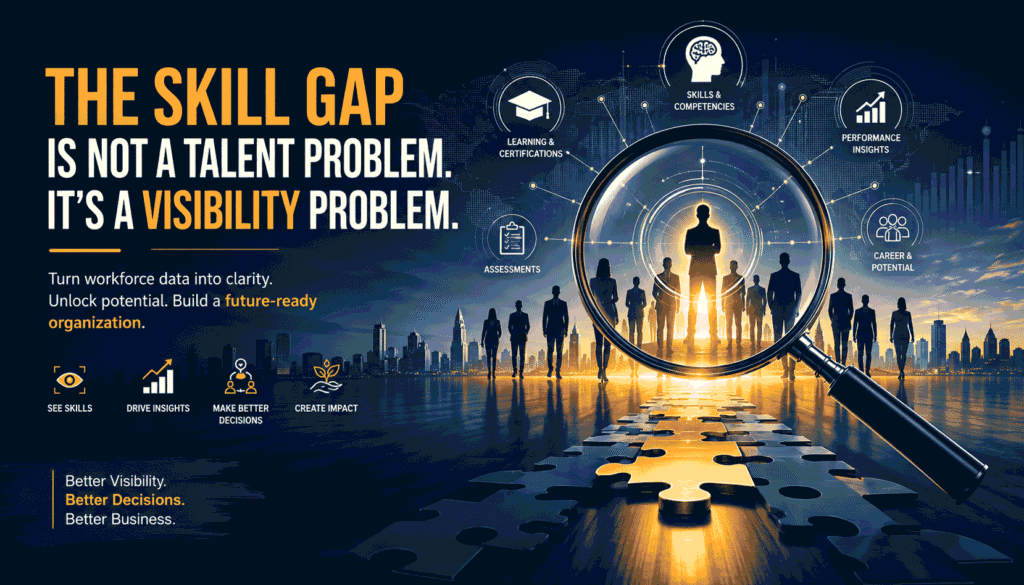
The challenge isn’t a shortage of talent. In most cases, the talent already exists within the organization. The real challenge is visibility—understanding who possesses which skills, how those skills are evolving, and where capability gaps may emerge in the future.
As businesses navigate rapid technological change, evolving market demands, and increasing competition, workforce visibility has become a strategic necessity rather than an HR initiative.
The Problem with Fragmented Workforce Data
Every employee leaves behind a trail of valuable information throughout their professional journey.
Learning platforms track completed courses and certifications. Performance systems record achievements and outcomes. Assessment tools measure competencies. Recruitment systems capture experiences and qualifications. Managers contribute observations and feedback.
Individually, each system provides useful information. Collectively, however, these data points often remain disconnected.
As a result, organizations gain fragmented insights rather than a comprehensive understanding of workforce capability. Leaders can see pieces of the puzzle, but not the complete picture.
This lack of visibility creates uncertainty in critical business decisions—from hiring and succession planning to learning investments and workforce strategy.
Why Traditional Talent Management Approaches Are No Longer Enough
For decades, organizations relied on job titles, qualifications, and performance ratings to make talent decisions. While these metrics remain important, they no longer provide a complete view of an individual’s potential.
Today’s workforce is dynamic. Skills are evolving faster than job descriptions. New technologies are creating entirely new competency requirements while making others less relevant.
In this environment, organizations need to move beyond static employee records and develop a deeper understanding of workforce capabilities.
The question is no longer, “What role does this employee hold?”
The question is, “What can this employee do today, and what can they become tomorrow?”
The Emergence of Talent Intelligence
Talent Intelligence represents a fundamental shift in how organizations understand and manage their workforce.
Instead of focusing solely on positions and organizational structures, Talent Intelligence focuses on capabilities, growth, and future readiness.
It creates a living view of workforce skills by bringing together information from multiple sources, including assessments, certifications, learning journeys, performance outcomes, and career progression.
This unified perspective allows organizations to identify existing strengths, uncover hidden potential, and anticipate future capability needs.
Most importantly, it transforms workforce planning from a reactive process into a proactive strategy.
Turning Workforce Data into Strategic Insight
When organizations gain visibility into workforce capabilities, the impact extends far beyond HR.
Business leaders can make more informed decisions about expansion plans, transformation initiatives, and talent investments.
Learning and development teams can align training programs with actual skill gaps rather than assumptions.
Managers can identify employees ready for new opportunities and provide targeted development pathways.
Executives can better understand organizational readiness and ensure the workforce is prepared for future challenges.
The result is a more agile, resilient, and future-ready organization.
Building a Workforce Prepared for What’s Next
The future of work will belong to organizations that can adapt quickly to change.
Adaptability, however, depends on understanding workforce capabilities at a deeper level.
Organizations that can identify emerging skill gaps early, develop talent strategically, and deploy capabilities effectively will gain a significant competitive advantage.
This requires moving beyond fragmented data and embracing a more holistic approach to workforce intelligence.
It requires visibility.
Because when organizations can clearly see the capabilities of their people, they can make better decisions, invest more effectively, and unlock greater business value.
The Way Forward
Every employee has a unique professional journey—a combination of experiences, skills, achievements, learning, and potential.
The organizations that succeed in the years ahead will be those that can connect these individual journeys into a meaningful understanding of workforce capability.
Talent Intelligence is not simply about collecting more data. It is about creating clarity.
It is about transforming information into insight, insight into action, and action into business impact.
In a world where skills are becoming the most valuable currency, visibility is no longer optional.
It is the foundation of every successful workforce strategy.
Because the future isn’t defined by the talent you hire. It’s defined by the talent you understand.
Conclusion
The future of workforce success will not be determined by the number of employees an organization has, but by how well it understands and develops their capabilities. As skill requirements continue to evolve at an unprecedented pace, organizations can no longer afford to rely on fragmented data, outdated job structures, or assumptions about talent.
True workforce transformation begins with visibility—the ability to see, measure, and understand the complete skills journey of every employee. When leaders gain a clear view of workforce capabilities, they can make smarter decisions, invest in the right development initiatives, identify future leaders, and proactively address emerging skill gaps.
In an increasingly competitive business environment, Talent Intelligence is no longer a luxury; it is a strategic imperative. Organizations that embrace it will be better equipped to build agile teams, drive innovation, and remain prepared for whatever the future brings.
Because better visibility leads to better decisions, and better decisions create stronger businesses.