
AI Is Transforming Work—But People Remain at the Center
Artificial Intelligence (AI) is rapidly transforming industries across the globe. From automating routine tasks to enabling data-driven decision-making, organizations are embracing AI to improve efficiency, productivity, and innovation. Nowhere is this transformation more visible than in operationally intensive sectors such as logistics, supply chain, manufacturing, and large-scale enterprise operations.
However, amid conversations about automation and technological advancement, one critical question remains:
How do organizations ensure that AI enhances human potential rather than replacing it?
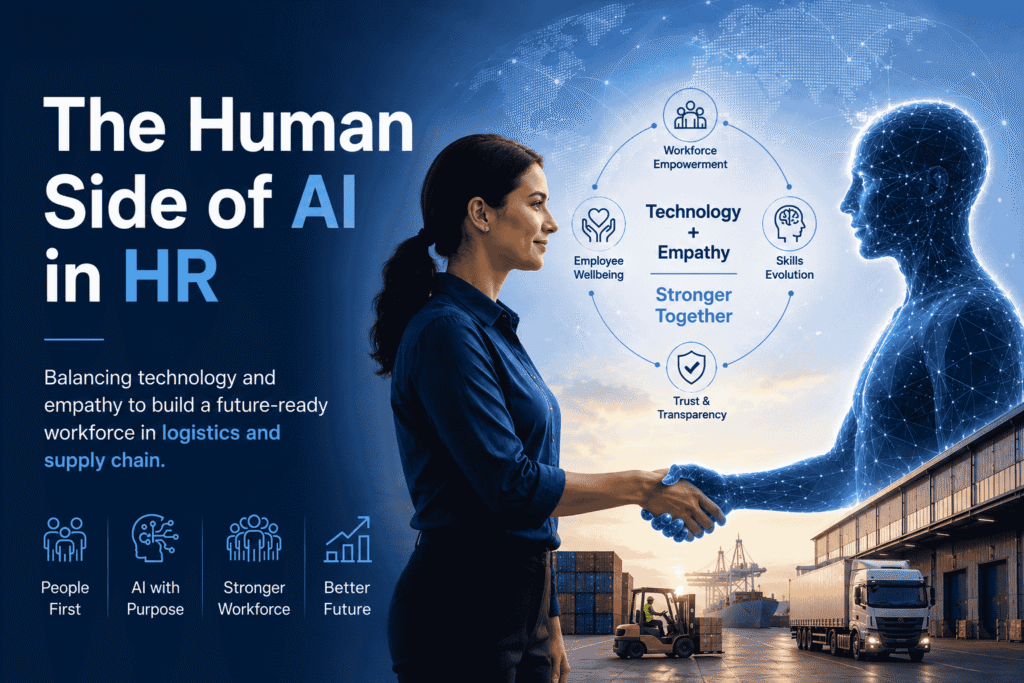
At ThirdBracket, we believe the future of work is not about humans versus machines—it is about humans and machines working together. The most successful organizations will be those that combine the power of AI with empathy, leadership, trust, and human-centered workplace practices.
The Rise of AI in Workforce Management
Today’s organizations manage increasingly complex workforces spread across warehouses, production facilities, transportation networks, remote teams, and corporate offices. AI is helping leaders navigate this complexity through:
- Workforce planning and forecasting
- Predictive hiring and talent acquisition
- Employee engagement analysis
- Performance management
- Learning and development personalization
- Operational productivity optimization
By analyzing large volumes of workforce data, AI can identify patterns that would be impossible for humans to detect manually. This allows HR teams and business leaders to make faster and more informed decisions.
Yet technology alone cannot build a thriving workplace.
While AI can process information, it cannot replace human judgment, emotional intelligence, creativity, or leadership. These uniquely human capabilities remain essential in building resilient and high-performing organizations.
Balancing Automation and Human Potential
One of the biggest challenges organizations face today is finding the right balance between automation and human contribution.
Automation is often introduced to eliminate repetitive tasks, reduce errors, and improve efficiency. However, when employees perceive technology as a threat rather than an enabler, resistance naturally emerges.
Forward-thinking organizations approach AI differently.
Instead of asking, “Which jobs can AI replace?” they ask:
“How can AI help our people perform at their best?”
This shift in mindset changes everything.
When AI is positioned as a tool that removes administrative burdens, employees gain more time for problem-solving, collaboration, customer service, innovation, and strategic thinking.
The goal should never be replacing people. The goal should be empowering people.
Responsible AI Adoption Starts with Leadership
Introducing AI into large organizations requires more than technological readiness—it requires leadership readiness.
Many enterprises operate across diverse workforce environments that include frontline employees, supervisors, plant managers, logistics teams, and corporate professionals. Each group experiences AI differently.
Leaders must address several critical questions:
- How will AI impact daily work?
- What tasks will change?
- What new skills will be required?
- How will employees be supported during the transition?
- How will fairness and transparency be maintained?
Without clear communication, uncertainty can quickly evolve into fear.
Responsible AI adoption requires leaders to create transparency around both the opportunities and limitations of technology. Employees need to understand why AI is being implemented and how it contributes to organizational success.
Trust is built when leaders communicate openly and involve employees in the transformation journey.
Building Human-Centric Operations in an AI-Driven World
In industries where productivity metrics and operational efficiency dominate decision-making, there is a risk of overlooking the human experience.
Organizations can become so focused on optimization that they unintentionally create disconnected workplaces.
This is where human-centric leadership becomes essential.
Human-centric organizations use AI to enhance employee experiences by:
Improving Employee Wellbeing
AI can help identify burnout risks, workload imbalances, and engagement challenges before they become larger issues.
Personalizing Learning
Employees can receive tailored development opportunities based on their career goals, skill gaps, and performance data.
Enhancing Employee Support
AI-powered assistants can provide immediate answers to HR-related questions, reducing frustration and improving accessibility.
Creating Better Work Experiences
By automating repetitive tasks, employees gain more time to focus on meaningful and rewarding work.
Technology should strengthen human connection—not weaken it.
Organizations that prioritize employee wellbeing alongside operational excellence are more likely to attract, retain, and engage top talent.
The Future of Skills: What HR Leaders Need to Know
The conversation around AI often focuses on jobs. However, the more important conversation is about skills.
As technology evolves, many job roles will change significantly. Employees will increasingly work alongside intelligent systems, requiring new capabilities that extend beyond traditional technical expertise.
Some of the most valuable future skills include:
Digital Literacy
Understanding how AI tools work and how to use them effectively will become a baseline expectation across industries.
Critical Thinking
Employees must be able to evaluate AI-generated insights, identify risks, and make informed decisions.
Problem Solving
As routine tasks become automated, human workers will focus on more complex challenges requiring creativity and innovation.
Adaptability
Continuous learning will become essential as technology continues to evolve.
Emotional Intelligence
Communication, collaboration, leadership, empathy, and relationship-building will become even more important in AI-enabled workplaces.
The future workforce will not be defined solely by technical skills. It will be defined by the ability to combine human strengths with technological capabilities.
Employee Trust: The Foundation of Successful AI Transformation
Perhaps the greatest challenge in AI adoption is employee trust.
Many employees worry that automation will eliminate jobs, reduce opportunities, or make their skills obsolete.
Ignoring these concerns can create resistance and slow transformation efforts.
Organizations must proactively address employee fears by:
Communicating Early and Often
Transparency reduces uncertainty. Employees should understand how AI initiatives align with business goals and workforce development strategies.
Investing in Reskilling
Providing learning opportunities demonstrates that the organization is committed to employee growth rather than replacement.
Involving Employees in Change Initiatives
People are more likely to support transformation when they have a voice in shaping it.
Demonstrating Positive Outcomes
Sharing success stories and real-world examples helps employees see the benefits of AI in practice.
Trust is not built through technology.
Trust is built through communication, consistency, and leadership.
Leadership in the Age of AI
The organizations that succeed in AI transformation will have leaders who embrace both innovation and humanity.
Future-ready leaders understand that technology adoption is not simply a systems project—it is a people project.
Effective leaders in AI-enabled organizations demonstrate:
- Curiosity about emerging technologies
- Commitment to lifelong learning
- Empathy toward employee concerns
- Transparency in decision-making
- Agility during periods of change
- Focus on long-term workforce development
Leadership today requires balancing operational performance with human experience.
The strongest cultures are built when employees feel supported, valued, and prepared for the future.
What the Future Workforce Will Look Like
Looking ahead, the future workforce will be more connected, data-driven, and technology-enabled than ever before.
AI will continue to automate routine processes, while humans focus on higher-value work that requires creativity, judgment, collaboration, and innovation.
Organizations that thrive will be those that:
- Invest in continuous learning
- Build skills-based talent strategies
- Foster adaptable workplace cultures
- Use AI responsibly and ethically
- Prioritize employee wellbeing
- Create opportunities for workforce growth
The future is not about replacing human talent.
It is about unlocking human potential.
Conclusion: AI Needs a Human Strategy
AI is reshaping the workplace at an unprecedented pace. Yet despite technological advances, one truth remains constant:
Organizations succeed because of people.
Technology can optimize processes, generate insights, and improve efficiency. But people bring vision, empathy, creativity, leadership, and purpose.
At ThirdBracket, we believe the future of work belongs to organizations that recognize this balance. The most successful companies will not be those with the most advanced AI systems alone. They will be those that combine intelligent technology with human-centered leadership and workforce transformation.
Because ultimately, the future of AI in HR is not just about technology.
It’s about people.