
Employee health has become an important part of building a productive, engaged, and sustainable workplace. Companies today understand that employee wellbeing is not limited to offering health insurance or occasional wellness activities. Employees need continuous support for their physical health, mental wellbeing, work-life balance, and overall workplace experience.
This is where technology can make a real difference.
From digital wellness platforms and mental health applications to fitness tracking tools and employee engagement software, organizations now have access to a wide range of solutions designed to support healthier employees.
In this guide, we explore the top digital tools for improving employee health, how they work, what benefits they offer, and how businesses can choose the right solutions for their workforce.
What Are Digital Tools for Employee Health?
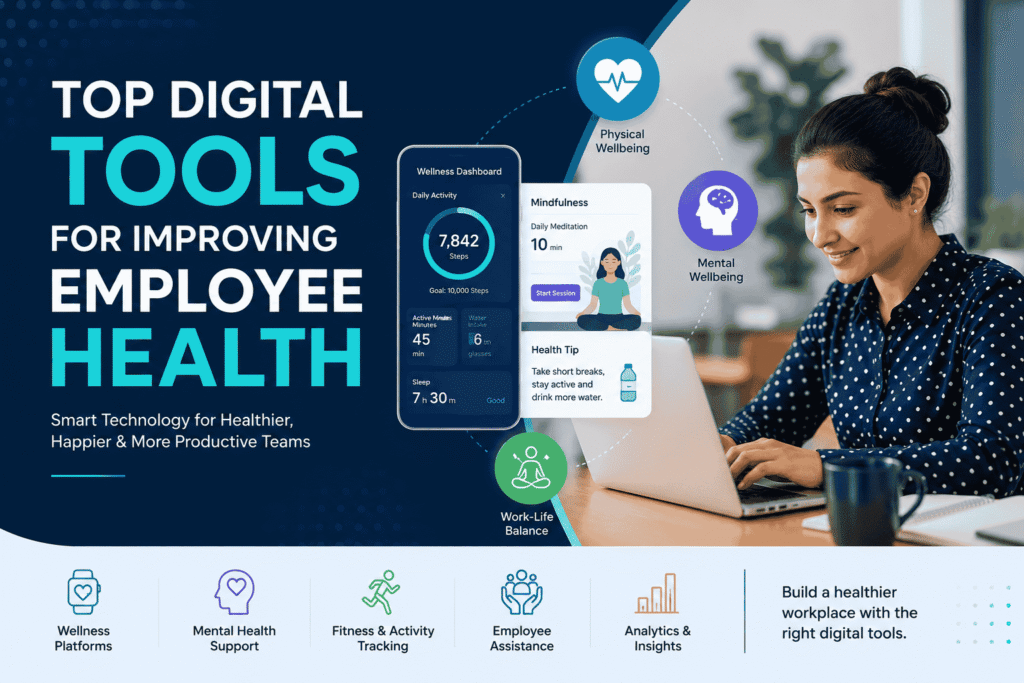
Digital tools for employee health are software platforms, applications, wearable technologies, and online services that help organizations support the physical, mental, and emotional wellbeing of their employees.
These tools can help companies:
- Encourage healthier daily habits
- Support employee mental wellbeing
- Promote physical activity
- Manage workplace stress
- Improve work-life balance
- Increase employee engagement
- Identify wellness trends
- Provide access to health resources
- Create personalized wellness programs
- Measure employee participation and outcomes
Modern HR teams can combine these technologies with their broader employee experience and talent strategies to create a more supportive workplace.
Why Are Employee Health Tools Important?
Employee health directly influences productivity, engagement, attendance, and retention. When employees feel physically and mentally well, they are generally better positioned to concentrate, collaborate, and perform their responsibilities effectively.
Traditional wellness programs often struggle because participation is difficult to track and employees may not receive personalized support.
Digital tools make wellness programs more accessible and measurable.
For example, an employee can use a mobile application to complete a wellness activity, participate in a fitness challenge, access mental wellbeing resources, or track personal goals. HR teams can then use aggregated insights to understand participation and improve future programs.
The key is to use technology as a support system rather than treating employee health as a simple data or productivity metric.
Top Digital Tools for Improving Employee Health
1. Employee Wellness Platforms
Employee wellness platforms are among the most comprehensive digital tools for workplace health.
These platforms bring multiple wellness activities together in one place. Depending on the solution, employees may get access to fitness challenges, nutrition resources, health education, wellness assessments, meditation programs, and other activities.
For HR teams, these platforms can make it easier to organize and manage workplace wellness initiatives.
Key benefits:
- Centralized wellness programs
- Employee participation tracking
- Health education resources
- Wellness challenges
- Personalized recommendations
- Reporting and analytics
A wellness platform can be particularly useful for organizations with distributed or hybrid teams because employees can access resources regardless of their location.
2. Mental Health and Wellbeing Apps
Mental wellbeing is now an important component of employee health.
Work pressure, long working hours, uncertainty, and poor work-life balance can contribute to stress and burnout. Digital mental wellbeing applications can provide employees with convenient access to resources such as guided meditation, mindfulness exercises, breathing techniques, sleep content, and professional support where available.
These tools should complement—not replace—professional medical or mental health care when such care is needed.
For organizations, the biggest advantage is accessibility. Employees can often use these resources privately and at a time that works for them.
Common features include:
- Meditation sessions
- Stress management exercises
- Mindfulness content
- Sleep support
- Mood and wellbeing check-ins
- Access to professional resources
3. Fitness and Activity Tracking Tools
Physical activity is another important part of employee wellness.
Fitness tracking applications and wearable devices can encourage employees to stay active throughout the day. Step challenges, activity goals, movement reminders, and team-based competitions can make wellness programs more engaging.
Organizations can incorporate these tools into voluntary workplace fitness initiatives.
For example, a company could organize a monthly walking challenge where employees participate individually or as teams.
Benefits include:
- Encouraging physical activity
- Creating social engagement
- Supporting healthy routines
- Making wellness programs interactive
- Providing employees with personal activity insights
However, participation should remain voluntary, and employers should be careful about collecting or accessing sensitive individual health information.
Internal Mobility Marketplace – CLICK HERE
4. Employee Assistance Platforms
Employee Assistance Programs, or EAPs, can provide employees with confidential support for personal and professional challenges.
Digital EAP platforms can make it easier for employees to find available resources and connect with appropriate support services.
Depending on the provider and plan, services may include support related to emotional wellbeing, financial concerns, family matters, legal questions, or workplace challenges.
Digital access can be especially valuable for remote employees who may not have easy access to traditional workplace support services.
5. Ergonomics and Workplace Health Tools
With remote and hybrid work becoming common, ergonomics has become an important part of employee health.
Employees may spend several hours working from laptops, desks, or home workstations. Poor workstation setup can contribute to discomfort and other physical problems.
Digital ergonomics tools can provide workstation assessments, educational content, posture guidance, movement reminders, and recommendations for improving a workspace.
Organizations can use these tools to educate employees about healthier working environments without requiring every employee to visit a physical workplace assessment facility.
6. Sleep and Recovery Apps
Sleep has a strong connection with overall wellbeing, energy, concentration, and daily performance.
Sleep-focused digital tools can help employees understand their sleep habits and encourage healthier sleep routines.
Some applications provide:
- Sleep tracking
- Relaxation exercises
- Guided audio
- Sleep reminders
- Breathing exercises
- Sleep education
Employers should position these tools as optional wellbeing resources rather than using employee sleep data to evaluate performance.
7. Nutrition and Healthy Lifestyle Apps
Nutrition is another area where digital technology can support employee wellbeing.
Nutrition applications can help users learn about healthy eating, meal planning, hydration, and dietary habits.
Organizations can include nutrition resources as part of broader employee wellness programs. For example, HR teams could organize healthy eating campaigns, educational sessions, or voluntary nutrition challenges.
The goal should be to provide useful information and encourage healthier choices rather than creating pressure around employees’ personal lifestyle decisions.
8. Digital Health Checkup Platforms
Digital health platforms can simplify access to certain health-related services and educational resources.
Depending on the platform and country, employees may be able to access health assessments, appointment-related services, health information, or virtual consultations.
For employers, such platforms can make healthcare resources more accessible, particularly for employees working remotely or in different geographic locations.
Organizations should carefully evaluate data protection, medical compliance, provider credentials, and employee consent before introducing such solutions.
9. Employee Engagement and Pulse Survey Tools
Employee health is not only about physical activity or medical support. Workplace culture and employee experience also influence wellbeing.
Pulse survey and employee engagement platforms allow HR teams to regularly collect feedback about workload, engagement, workplace experience, and other organizational factors.
Short surveys can help organizations identify potential issues before they become larger problems.
For example, if employees consistently report high workload levels or low work-life balance, HR and managers can investigate the underlying causes.
The important point is that employee surveys should lead to action. Asking employees for feedback without addressing recurring concerns can reduce trust.
10. HR Analytics and People Analytics Platforms
HR analytics platforms can bring employee data together to help organizations understand workforce trends.
When used responsibly and with appropriate privacy safeguards, people analytics can help HR teams identify patterns related to absenteeism, engagement, retention, workload, and employee experience.
This can help organizations move from reactive HR management toward proactive workforce planning.
For example, HR leaders can examine aggregated trends to understand whether certain teams are experiencing consistently high workloads or declining engagement.
The objective should not be to monitor individual employees’ health. Instead, analytics should help organizations identify workplace-level issues and make better decisions.
See What AI Changes in Every Job – Work Intelligence Index
How to Choose the Right Employee Health Tool
With so many digital wellness solutions available, choosing the right technology can be challenging.
Before selecting a platform, HR leaders should consider several factors.
1. Employee Needs
Start by understanding what employees actually need.
A company with a young, distributed workforce may prioritize fitness and mental wellbeing applications, while an organization with a large desk-based workforce may benefit more from ergonomics and workplace wellness solutions.
2. Ease of Use
A sophisticated platform is not useful if employees do not want to use it.
Look for simple interfaces, mobile accessibility, intuitive navigation, and easy onboarding.
3. Privacy and Data Security
Employee health information can be highly sensitive.
Companies should carefully review how a tool collects, stores, processes, and shares data. Employees should clearly understand what information is being collected and why.
Whenever possible, organizations should use aggregated or anonymized information for workplace-level reporting.
4. Integration With HR Systems
Integration can make employee wellness technology easier to manage.
A platform that can connect with existing HR technology, employee engagement systems, or workforce platforms may reduce administrative work and create a more connected employee experience.
5. Analytics and Reporting
HR teams need to understand whether wellness initiatives are actually being used.
Look for tools that provide meaningful reporting around participation, engagement, and program outcomes without compromising employee privacy.
6. Scalability
The right solution should be able to grow with your organization.
A platform that works for 100 employees may not provide the same experience when the workforce grows to several thousand people.
How Digital Tools Can Improve Employee Health Outcomes
Technology alone cannot create a healthy workplace. The biggest impact comes when digital tools are combined with supportive policies, good management, reasonable workloads, and a positive workplace culture.
Organizations can use digital health tools to:
- Make wellness resources easier to access
- Encourage healthy habits
- Improve employee engagement
- Support remote and hybrid workers
- Identify workplace wellbeing trends
- Personalize wellness experiences
- Give employees greater flexibility
- Help HR teams make data-informed decisions
However, companies should avoid turning wellness technology into another form of employee surveillance.
A healthy workplace should give employees control over their personal health information and make wellness participation voluntary wherever appropriate.
The Future of Digital Employee Health
The future of workplace wellbeing is likely to become increasingly personalized and data-driven.
Artificial intelligence, predictive analytics, wearable technology, digital coaching, and integrated HR platforms are making it possible to deliver more relevant employee experiences.
AI-powered systems may help HR teams identify workforce-level patterns, recommend relevant wellness resources, and understand how employee experience changes over time.
At the same time, organizations will need to pay greater attention to privacy, transparency, consent, and responsible use of employee data.
The most successful companies will not simply adopt more technology. They will use technology thoughtfully to solve genuine employee problems.
Final Thoughts
The top digital tools for improving employee health range from wellness platforms and mental wellbeing applications to fitness trackers, ergonomics tools, employee assistance platforms, engagement surveys, and HR analytics solutions.
Each organization has different employee needs, so there is no single tool that works for everyone.
The best approach is to understand employee challenges first and then select technology that makes health and wellbeing support more accessible, useful, and measurable.
For HR leaders, the long-term goal should be bigger than increasing participation in wellness programs. It should be about creating a workplace where employees have the resources, flexibility, support, and environment they need to perform at their best.
As HR technology continues to evolve, organizations that combine digital tools with a genuine people-first culture will be better positioned to build healthier, more engaged, and more resilient workforces.
Visit us For More – THIRDBRACKET.IN