
Introduction
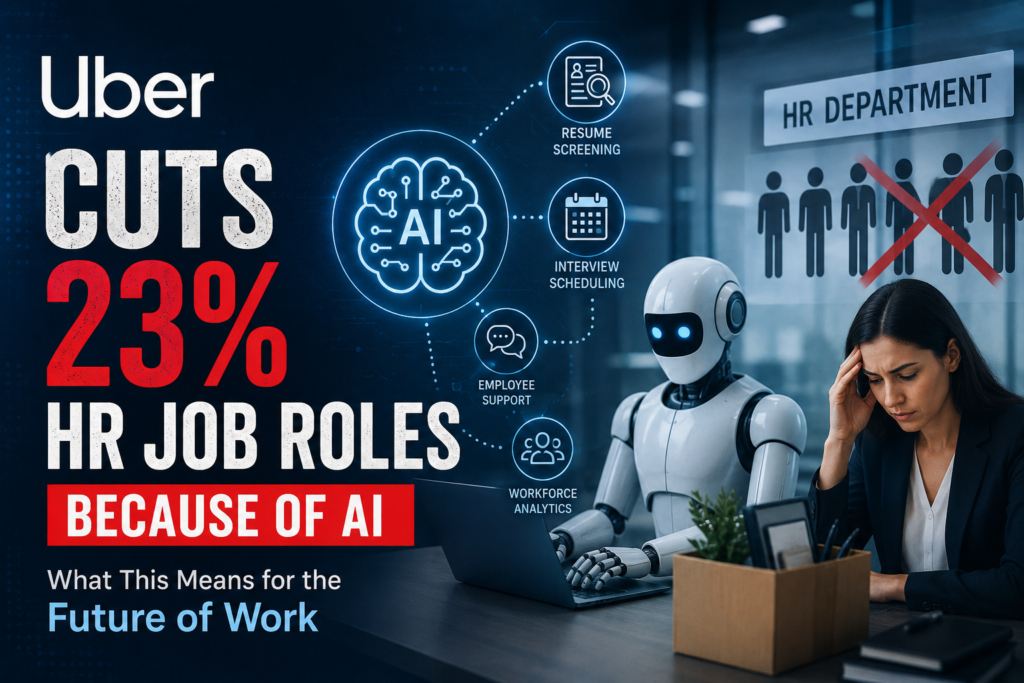
Artificial Intelligence (AI) is no longer a futuristic concept—it is transforming industries, businesses, and job roles across the globe. In one of the most significant workforce restructuring moves of recent times, Uber has reportedly reduced approximately 23% of its Human Resources (HR) roles as part of its broader AI-driven operational strategy.
This decision has sparked conversations across the corporate world about the impact of AI on employment, particularly in administrative and support functions. While AI promises increased efficiency, cost savings, and faster decision-making, it also raises important questions about job security, workforce transformation, and the future of human involvement in business operations.
In this article, we explore why Uber made this move, how AI is changing HR functions, and what it means for employees and organizations worldwide.
Why Did Uber Cut HR Roles?
Companies today face increasing pressure to optimize costs while maintaining productivity. AI-powered tools have become capable of handling many repetitive and data-driven HR tasks that previously required large teams.
Some of the HR functions that can now be automated include:
- Resume screening and candidate shortlisting
- Interview scheduling
- Employee onboarding processes
- Payroll assistance
- Benefits administration
- Employee query management through AI chatbots
- Performance tracking and reporting
By integrating AI systems into these operations, companies can significantly reduce manual work and improve efficiency.
For Uber, adopting AI-driven HR solutions appears to be part of a broader strategy to streamline operations and focus human resources on higher-value tasks rather than routine administrative activities.
The Growing Influence of AI in Human Resources
Human Resources has traditionally been viewed as a people-centric department. However, modern HR functions increasingly rely on data analytics, automation, and predictive technologies.
AI tools are now capable of:
Faster Recruitment
Recruiters often receive hundreds or even thousands of applications for a single role. AI-powered recruitment platforms can analyze resumes within seconds and identify the most relevant candidates based on predefined criteria.
Enhanced Employee Experience
AI chatbots can answer employee questions 24/7 regarding company policies, leave balances, benefits, and workplace procedures, reducing the burden on HR teams.
Predictive Workforce Analytics
Organizations can use AI to predict employee turnover, identify skill gaps, and forecast future hiring needs based on business growth trends.
Automated Documentation
Employment contracts, onboarding forms, compliance documents, and policy acknowledgments can be generated and processed automatically.
As these technologies mature, companies require fewer personnel to handle repetitive HR tasks.
Is AI Replacing Human Resources Professionals?
The answer is both yes and no.
AI is replacing specific tasks rather than completely eliminating the HR profession. Functions that involve repetitive processes, large-scale data analysis, and administrative work are increasingly being automated.
However, many HR responsibilities still require human judgment, empathy, and interpersonal skills.
These include:
- Employee relations
- Conflict resolution
- Leadership development
- Organizational culture management
- Diversity and inclusion initiatives
- Strategic workforce planning
- Executive coaching
While AI can support these functions, it cannot fully replace the human element necessary for effective people management.
Therefore, the future of HR is likely to involve collaboration between AI systems and HR professionals rather than complete replacement.
The Business Case Behind AI Adoption
From a business perspective, AI offers several advantages.
Cost Reduction
Organizations can lower operational expenses by automating routine processes and reducing dependency on large administrative teams.
Increased Productivity
AI systems work continuously without fatigue, enabling faster processing of tasks and improved operational efficiency.
Improved Accuracy
Human errors in data entry, payroll calculations, compliance reporting, and document management can be minimized through automation.
Better Decision-Making
AI-driven analytics provide leaders with real-time insights, helping them make informed workforce and business decisions.
For companies operating at Uber’s scale, even small efficiency improvements can translate into millions of dollars in savings annually.
What Does This Mean for Employees?
Uber’s workforce reduction highlights an important reality: the nature of work is changing rapidly.
Employees across industries should view AI not as a threat but as a signal to adapt and evolve.
The most vulnerable roles are typically those involving:
- Repetitive administrative tasks
- Data entry
- Routine reporting
- Basic customer support
- Standardized operational processes
Workers who rely solely on these skills may face increasing competition from automation technologies.
Skills That Will Remain Valuable
The demand for uniquely human capabilities is expected to grow.
These include:
Critical Thinking
Businesses need employees who can analyze complex situations and make strategic decisions.
Emotional Intelligence
Managing people, understanding emotions, and building relationships remain difficult for AI systems.
Creativity
Innovation, problem-solving, and creative thinking continue to be areas where humans excel.
Leadership
Organizations will always require leaders who can inspire teams and drive organizational change.
AI Management
Professionals who understand how to work with AI tools and manage automated systems will become increasingly valuable.
The Rise of AI-Augmented Jobs
Rather than eliminating jobs entirely, AI is creating a new category of work known as AI-augmented roles.
In these positions, employees use AI tools to enhance productivity rather than being replaced by them.
Examples include:
- Recruiters using AI for candidate screening
- Marketers leveraging AI-generated content
- Customer support teams working alongside AI chatbots
- Financial analysts using predictive AI models
- HR managers utilizing workforce analytics platforms
Employees who learn to collaborate with AI technologies are likely to remain competitive in the evolving job market.
The Impact on the Global Workforce
Uber’s decision reflects a larger trend occurring across industries worldwide.
Major organizations in technology, finance, consulting, healthcare, and retail are investing heavily in AI-powered automation.
According to industry estimates, millions of jobs globally may undergo transformation over the next decade as businesses embrace AI technologies.
However, history shows that technological revolutions often create new opportunities alongside disruption.
Just as the internet created entirely new industries and career paths, AI is expected to generate demand for:
- AI specialists
- Data scientists
- Machine learning engineers
- AI trainers
- Prompt engineers
- Automation consultants
- Digital transformation managers
The challenge for workers is ensuring they possess the skills needed for these emerging opportunities.
How Businesses Should Respond
Organizations must balance efficiency gains with employee well-being.
Responsible AI adoption requires:
Transparent Communication
Employees should understand why changes are being implemented and how their roles may evolve.
Reskilling Programs
Companies should invest in training initiatives that help employees transition into new roles.
Ethical AI Practices
Organizations must ensure AI systems operate fairly and do not introduce bias into hiring, promotion, or performance management processes.
Human-Centered Leadership
Even in highly automated workplaces, maintaining trust, culture, and employee engagement remains essential.
Businesses that successfully combine technology with human talent will be best positioned for long-term success.
Lessons from Uber’s AI-Driven Restructuring
The reduction of HR roles at Uber is more than a company-specific event—it represents a broader shift in how organizations view workforce management.
Key takeaways include:
- AI is becoming a core business tool rather than an experimental technology.
- Administrative functions are increasingly susceptible to automation.
- Employees must continuously upgrade their skills.
- Human-centered capabilities remain highly valuable.
- Companies need responsible strategies for workforce transformation.
The organizations and professionals that adapt quickly will gain a competitive advantage in the AI-driven economy.
Conclusion
Uber’s decision to cut approximately 23% of its HR roles serves as a powerful reminder that artificial intelligence is reshaping the workplace at an unprecedented pace. While automation can improve efficiency and reduce costs, it also challenges traditional employment structures and job roles.
Rather than fearing AI, employees and organizations should focus on adaptation, learning, and innovation. The future of work will likely belong to those who can combine human creativity, emotional intelligence, and strategic thinking with the power of artificial intelligence.
As AI continues to evolve, one thing is clear: the workforce of tomorrow will look very different from the workforce of today. The question is not whether AI will change jobs—it already is. The real question is how prepared individuals and businesses are for the transformation ahead.